Polar moment of area and torsional constant J are often treated as though they were the same section property. That shortcut is valid for circular sections, but it can produce serious errors when applied to W-shapes, channels, angles, rectangular HSS, and most other structural steel profiles.
The confusion is understandable. Both properties have units of length to the fourth power, both relate in some way to rotation about a longitudinal axis, and the symbol J is sometimes used for either property in textbooks, CAD reports, and engineering software. Their mathematical meaning and practical use, however, are different.
What Is the Polar Moment of Area?
The polar moment of area is a geometric measure of how area is distributed around a selected point in a cross-section. For perpendicular centroidal axes x and y, it is calculated as:
Jp = Ix + Iy
Here, Ix and Iy are the second moments of area about the two perpendicular axes. The notation Jp is useful because it distinguishes the polar moment from the torsional constant commonly labeled J in structural steel tables.
The polar moment depends on the reference point. When the axes pass through the section centroid, the result is the centroidal polar moment. A CAD system can usually derive it directly from the reported centroidal area moments.
What Is the Torsional Constant J?
The torsional constant describes a section’s resistance to Saint-Venant torsion. In an idealized prismatic member under uniform torsion, the rate of twist is related to applied torque, material shear modulus, and the torsional constant. This relationship is commonly represented in conceptual form as:
twist per unit length = T / (GJ)
This expression is not a complete design procedure. End restraint, load position, warping, local behavior, connection flexibility, and stability may also affect a real steel member. It does show why the correct value of J matters: using an unrelated area property can substantially misrepresent torsional stiffness.
Unlike the polar moment, the torsional constant reflects the way shear stresses flow through the section under torsion. For noncircular shapes, that behavior depends on whether the section is open or closed, its wall arrangement, and the relative thicknesses of its elements.
When Are the Two Properties Equal?
For a solid circular section or a circular tube, the Saint-Venant torsional constant equals the polar second moment of area about the center. Circular geometry permits the section to twist without the nonuniform warping behavior characteristic of many noncircular profiles.
That equality should not be generalized to other steel shapes. A rectangular bar, rectangular HSS, W-shape, channel, tee, or angle may have a polar moment that is much larger than its torsional constant. Adding Ix and Iy for one of these sections does not produce the correct torsional property.
How Common Steel Shapes Behave
| Section type | Relevant torsional behavior | Practical property guidance |
|---|---|---|
| Round bar or round HSS | Circular symmetry supports uniform torsional behavior. | The polar moment and Saint-Venant torsional constant coincide about the center. |
| Rectangular bar | Noncircular geometry causes nonuniform shear stress and cross-section warping. | Do not substitute Ix + Iy for the torsional constant. |
| Rectangular or square HSS | The closed wall provides an efficient continuous shear-flow path. | Use a verified tabulated or appropriately calculated torsional constant. |
| W-shape, channel, angle, or tee | These are open sections with relatively low Saint-Venant torsional stiffness. | Use the published J and consider whether warping behavior is also relevant. |
| Built-up section | Behavior depends on whether components create an open, closed, or intermittently connected assembly. | Evaluate the actual assembled geometry and connection between components. |
Open Steel Sections
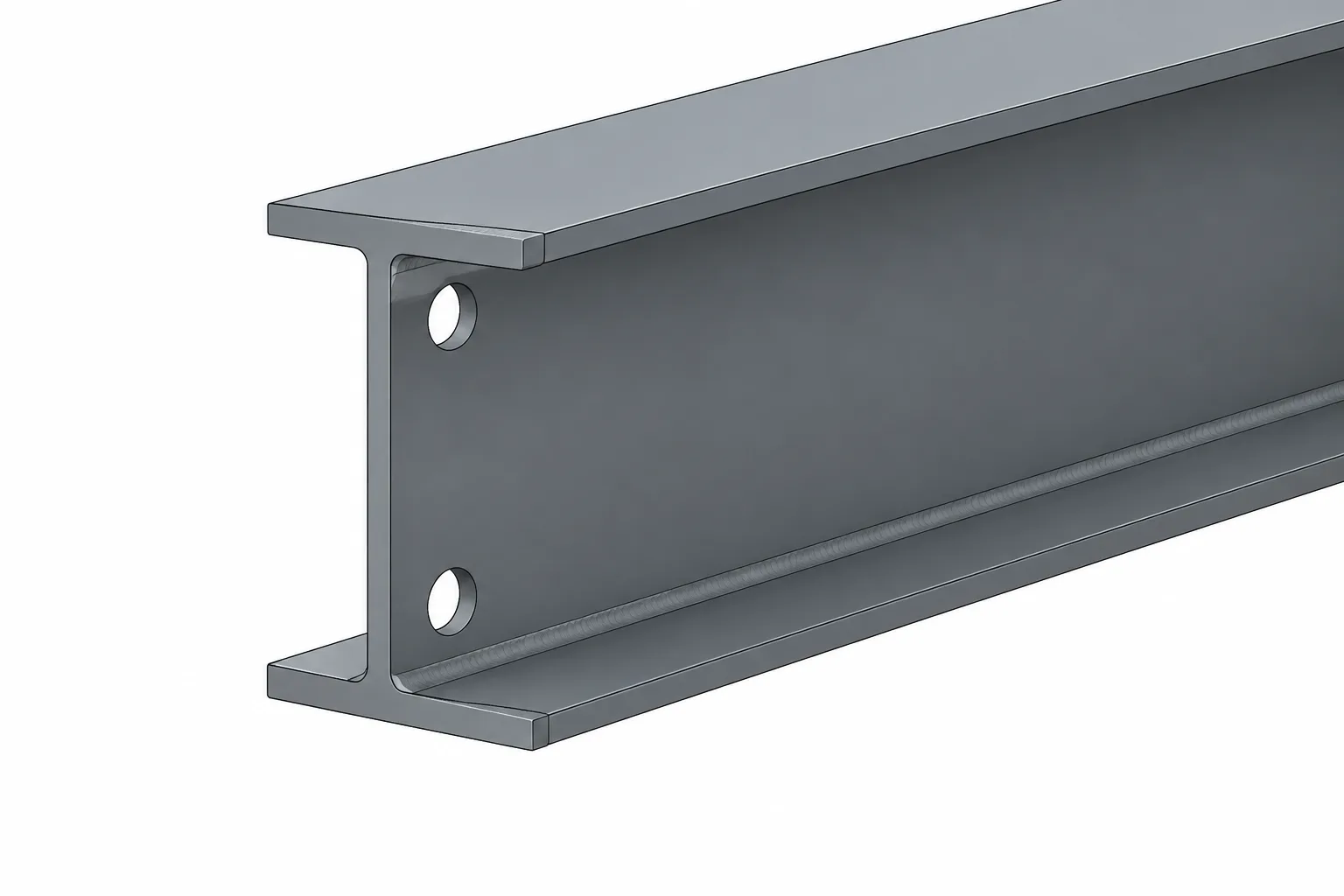
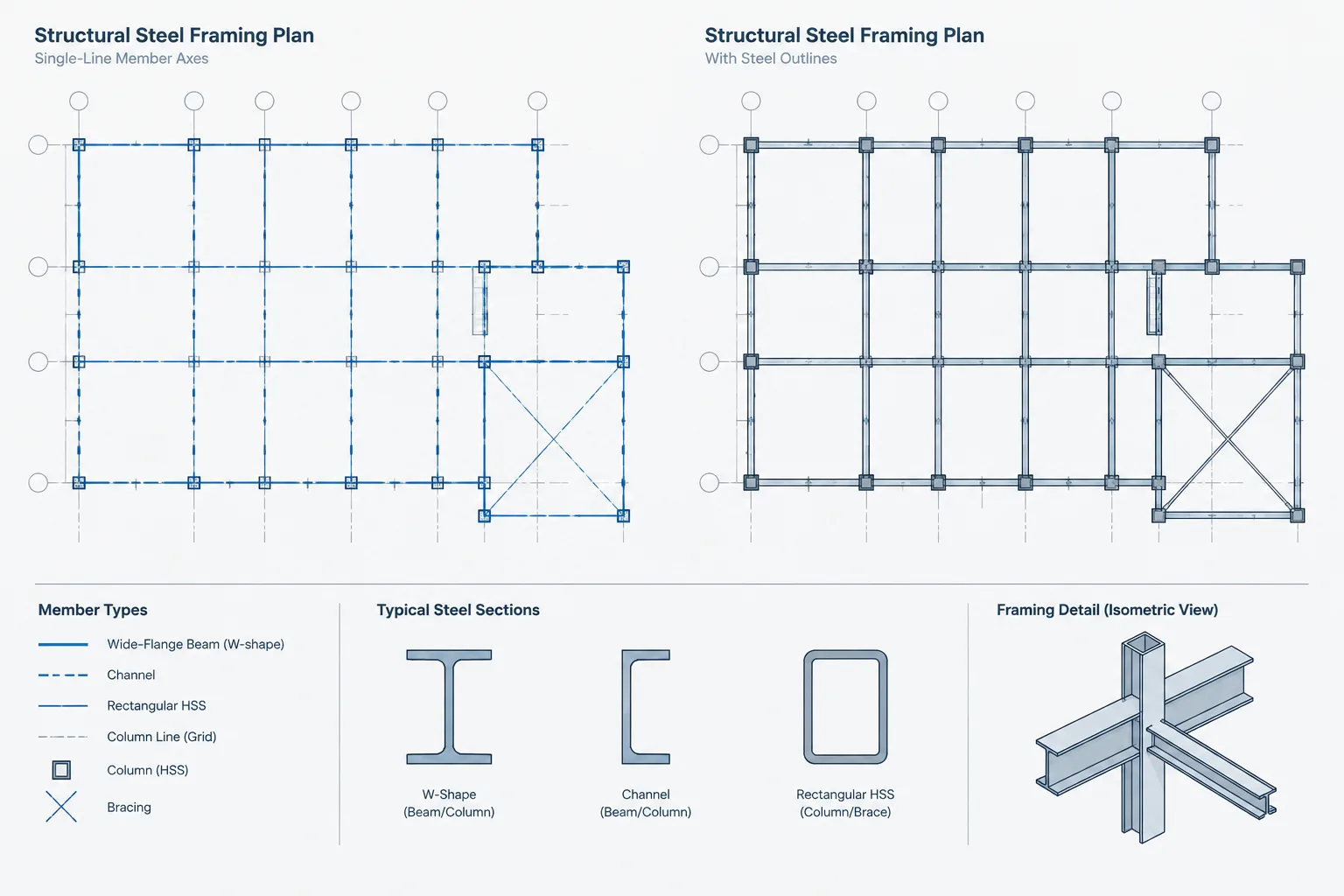
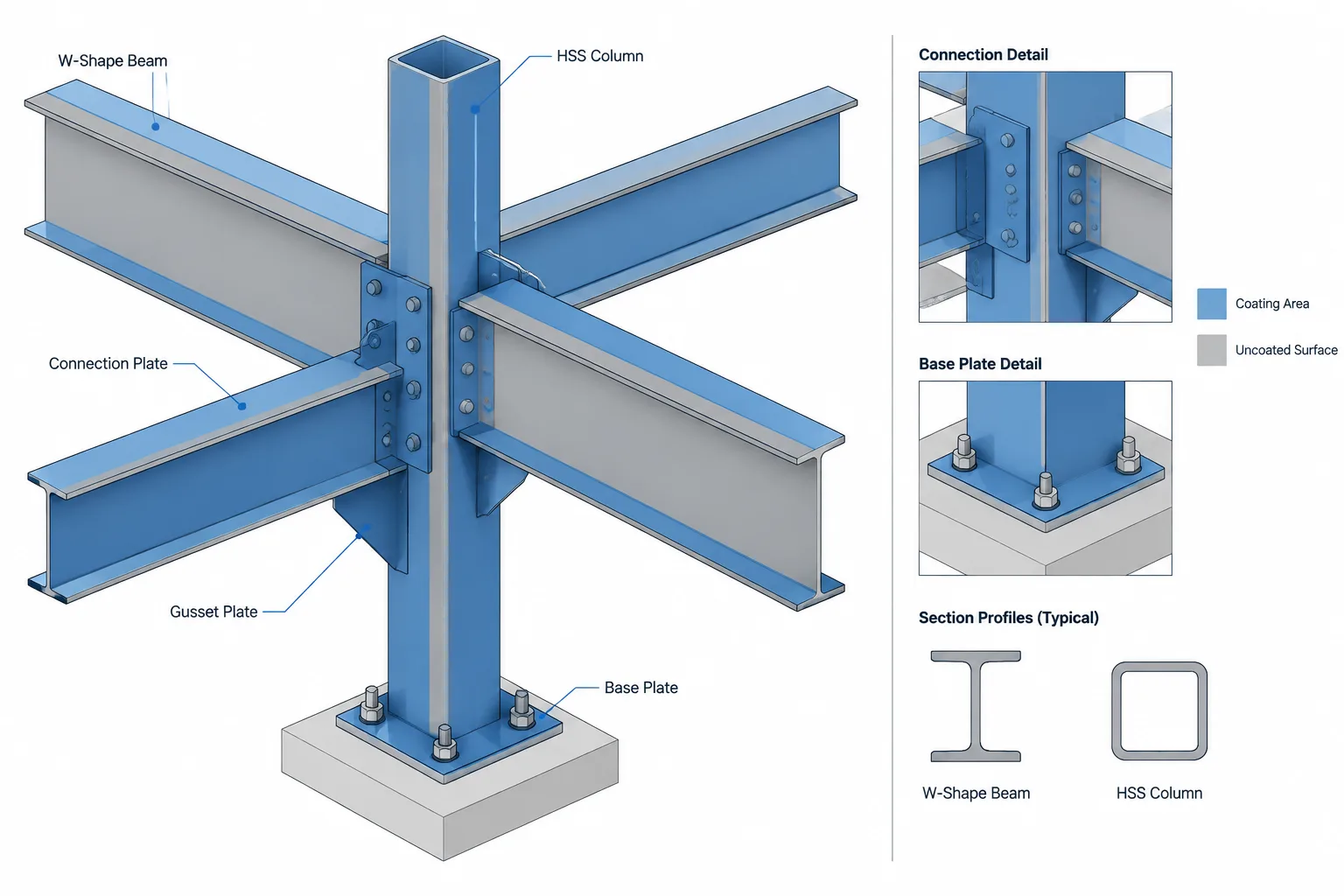
W-shapes, channels, angles, and structural tees are open sections. Their individual plates or rolled elements do not form a continuous closed cell. Under torsion, these sections may twist readily and develop warping displacement along the member.
For thin open elements, the torsional constant is strongly influenced by element thickness. This is one reason a visually deep W-shape can still have limited resistance to twisting. Overall depth and flange width may produce large bending moments of inertia while contributing much less than expected to Saint-Venant torsional stiffness.
Closed HSS Sections
Round, square, and rectangular HSS provide a closed path for torsional shear flow. Closed sections are generally much more efficient in torsion than comparable open sections because shear can circulate around the wall.
For round HSS, the circular relationship between polar moment and torsional constant applies. For square and rectangular HSS, it does not. Their torsional properties depend on the enclosed geometry, wall thickness, and corner configuration. Published section-property data should be used when the listed product matches the member being evaluated.
Built-Up and Intermittently Connected Members
A pair of channels, angles, or other components does not automatically behave as a closed section merely because its overall outline looks box-like in elevation. The load-transfer capability and spacing of welds, bolts, battens, or lacing affect whether torsional shear can develop around the assembly.
A CAD union of multiple profiles may return the area properties of a single combined region. That result does not prove that the fabricated member has the same torsional behavior as a continuously connected closed section.
Why CAD Property Reports Can Be Misleading
Many CAD workflows calculate area, centroid, Ix, and Iy from a closed two-dimensional boundary. A report may also include a quantity called polar moment or simply J. Before using that value, determine how the program defines it.
- If it is calculated as Ix + Iy, it is the polar moment of area.
- If it is based on a torsion solution for the actual cross-section, it may represent the Saint-Venant torsional constant.
- If the documentation is unclear, do not assume the reported value matches the J in a structural steel shape table.
- Confirm that the property is taken about the intended centroidal axes and that the profile is modeled correctly.
CAD geometry can also differ from the geometry underlying published properties. Simplified square corners, omitted rolled fillets, nominal wall outlines, duplicated boundaries, or disconnected regions can change calculated results. A precise-looking decimal output does not establish that the model or property definition is appropriate.
Torsional Constant J Is Not the Warping Constant Cw
Open sections can resist torsion through both Saint-Venant action and restrained warping. The torsional constant J relates to Saint-Venant torsion, while the warping constant Cw is associated with nonuniform warping behavior.
These properties are not interchangeable. A member’s actual response can depend on span, bracing, end restraint, load application, section symmetry, and connection details. A shape-table value of J alone does not describe every torsional limit state or stability concern.
A Practical Verification Workflow
- Identify the required property. Decide whether the task concerns planar bending, polar area distribution, Saint-Venant torsion, warping, or a combination.
- Check the notation. Determine whether the source uses J for polar moment or for torsional constant.
- Classify the cross-section. Note whether it is circular, noncircular solid, open thin-walled, closed thin-walled, or built up.
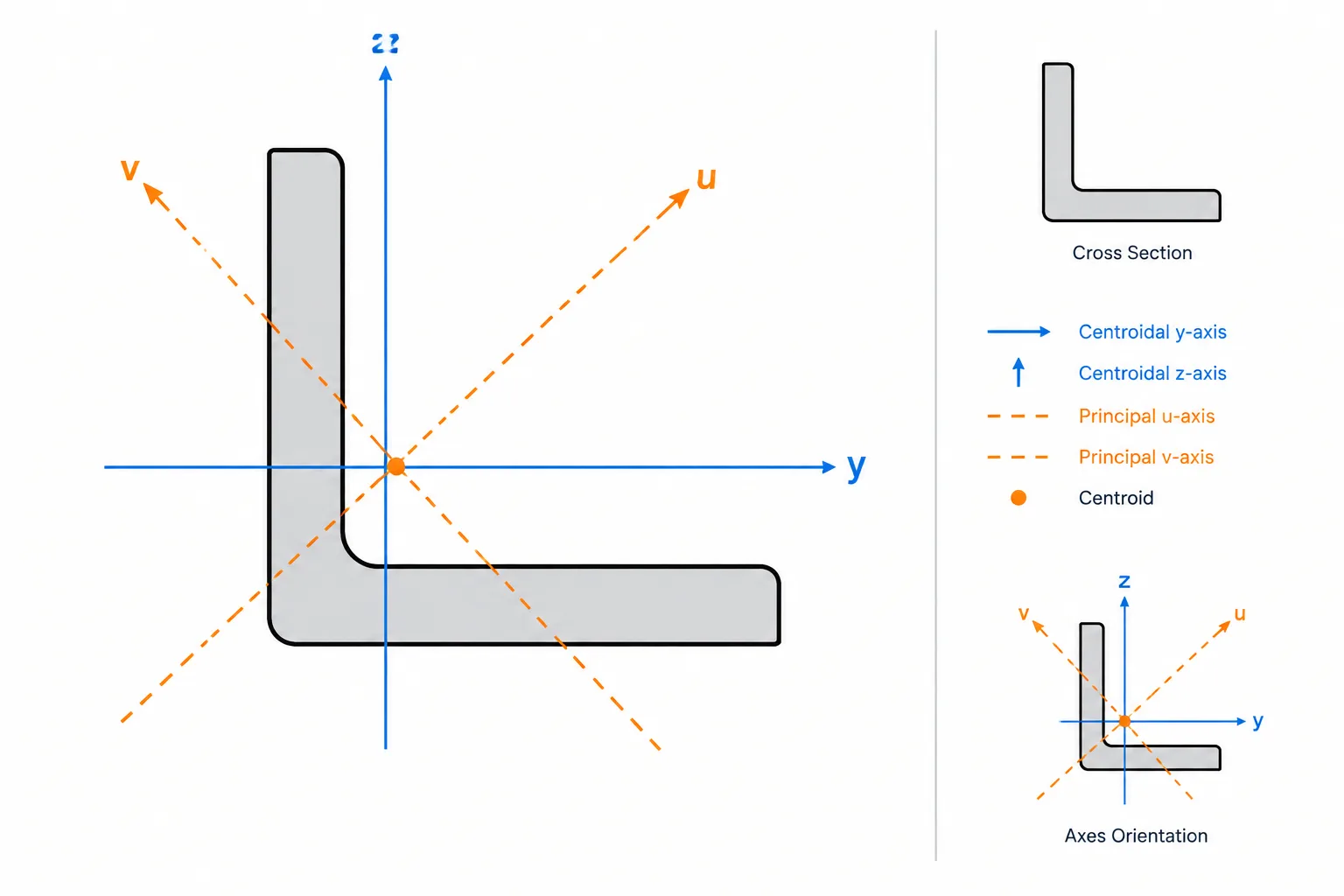
- Confirm the reference axes. Verify the centroid, axis orientation, and member longitudinal direction.
- Use verified shape data where available. For standard rolled shapes and HSS, consult an appropriate published section-property source rather than reconstructing J from basic CAD moments.
- Review modeled geometry. Check wall representation, fillets, corners, gaps, overlaps, and component connectivity.
- Evaluate the whole structural condition. Consider restraint, load eccentricity, bracing, warping, and connection behavior rather than relying on one section property.
Key Takeaway
The polar moment of area is the sum of two perpendicular area moments about a point. The torsional constant J measures Saint-Venant torsional stiffness. They are equal for circular sections, but they are generally not equal for the structural steel shapes most often encountered in framing and detailing.
When a CAD report, spreadsheet, or shape table labels a value as J, verify the definition before using it. For W-shapes, channels, angles, tees, and rectangular HSS, replacing the published torsional constant with Ix + Iy is not a valid shortcut.