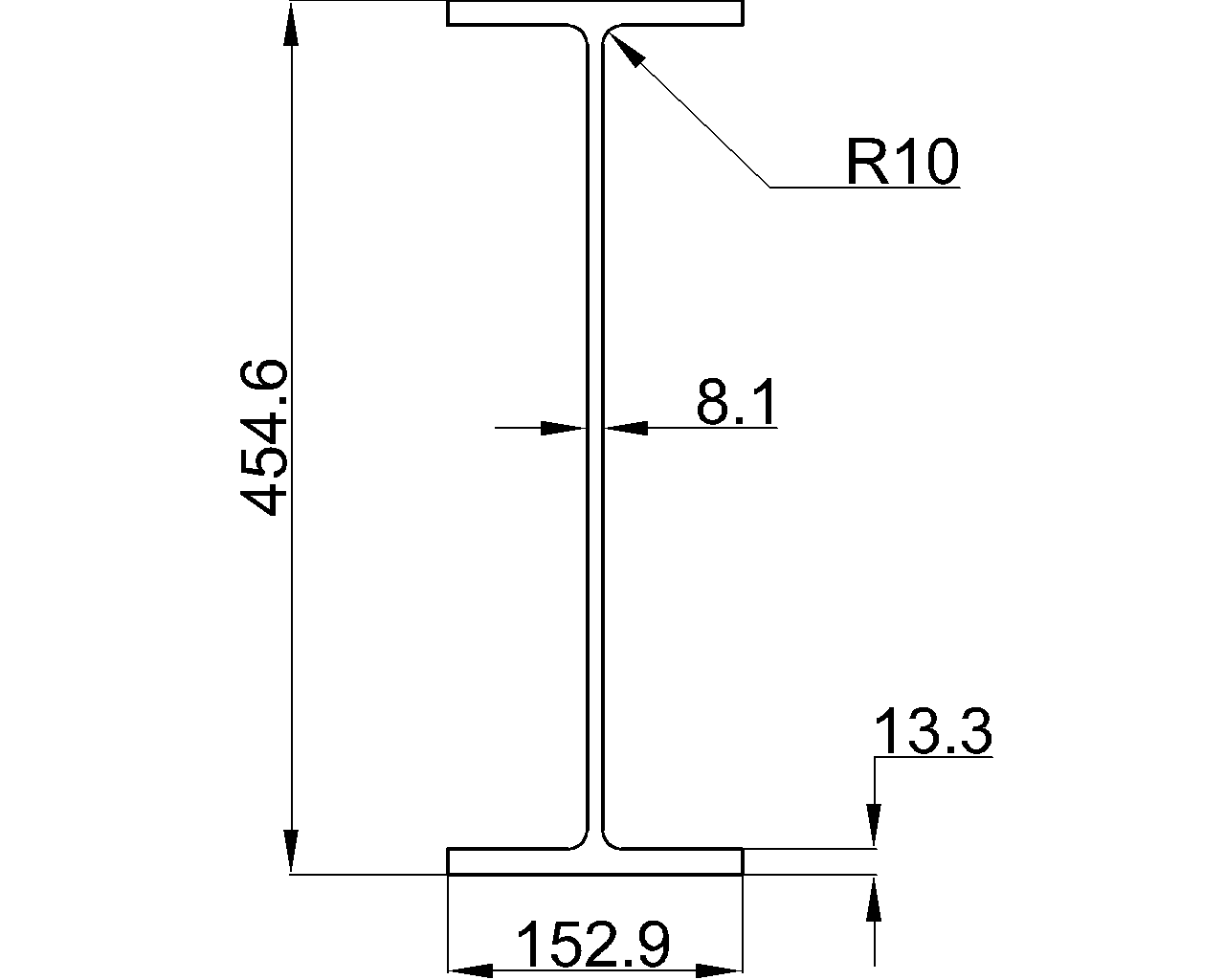
The UB 457x152x60 is a Universal Beam reference for checking the standard designation, overall dimensions, and published section data before design or detailing work. This page preserves the authoritative local values and adds guidance for interpreting them.
Use the dimensions below alongside the relevant EN 10365 reference, steel grade information, connection details, and project design requirements. For drawings, the downloadable DWG file can support drafting and coordination, but it should be checked against the project model and fabrication requirements.
UB 457x152x60
Universal Beams
refer to : EN 10365:2017
a European standard that defines the dimensions, tolerances, and sectional properties for hot-rolled steel channels, I-beams, and H-beams used in construction and engineering. It ensures uniformity and compatibility across European structural steel products.
Dimension : 454.6×152.9×8.1×13.3
Depth : 454.6 mm
Width : 152.9 mm
Web Thickness : 8.1 mm
Flange Thickness : 13.3 mm
Root Fillet Radius : 10 mm
Sectional Area : 76.2 cm2
Unit Weight : 59.8 kg/m
How to read the UB 457x152x60 reference
The UB designation identifies a Universal Beam section. The source dimensions describe the section depth, flange width, web thickness, and flange thickness. These dimensions help users distinguish the profile from similar beam sizes and provide the starting point for checking clearances, interfaces, and connection detailing.
The listed root fillet radius is important when a connection, plate, stiffener, coping detail, or adjacent component approaches the inside corner of the section. Do not treat the flange-to-web intersection as a sharp corner when preparing fabrication or fit-up details.
Section data for design and drafting
The sectional area and unit weight are useful for material takeoff, self-weight review, member scheduling, and coordination with analysis or estimating information. They do not, by themselves, establish the beam’s resistance, deflection performance, stability, or suitability for a particular structure. Those checks require the applicable steel grade, loading, restraint conditions, connection design, and governing engineering requirements.
Using the CAD reference
The DWG download provides a practical starting point for drawings and layout work. Confirm units, insertion scale, profile orientation, layer conventions, and any project-specific drafting requirements before issuing a drawing. CAD geometry should be checked against the published source dimensions rather than being treated as a substitute for engineering verification.
For related reference work, see the site’s guides to Universal Beam terminology, steel connections, section properties, and structural steel CAD resources.
Frequently asked questions
What does UB 457x152x60 mean?
It is the designation for a Universal Beam section. The page’s source data provides the corresponding dimensions, sectional area, and unit weight for reference.
Which standard is referenced for this section?
The source identifies EN 10365:2017 as the referenced standard for the listed Universal Beam information.
Why is the root fillet radius relevant?
The root fillet affects the inside corner where the web and flange meet. It should be considered when detailing plates, stiffeners, connection components, or other parts that may approach that region.
Can the listed unit weight be used for structural design?
It can support material and self-weight checks, but it is not sufficient to verify a member for a specific application. Design verification must also consider the project loads, restraints, steel grade, connections, and applicable engineering requirements.
Is the DWG file ready for fabrication?
The DWG is a drafting reference. Verify its geometry, units, scale, orientation, and project-specific requirements before using it in issued drawings or fabrication documentation.


