UB 1016x305x350 identifies a hot-rolled universal beam profile referenced here to EN 10365:2017. This page brings together the listed section dimensions, sectional area, unit weight, and associated DWG resource for drafting and technical reference.
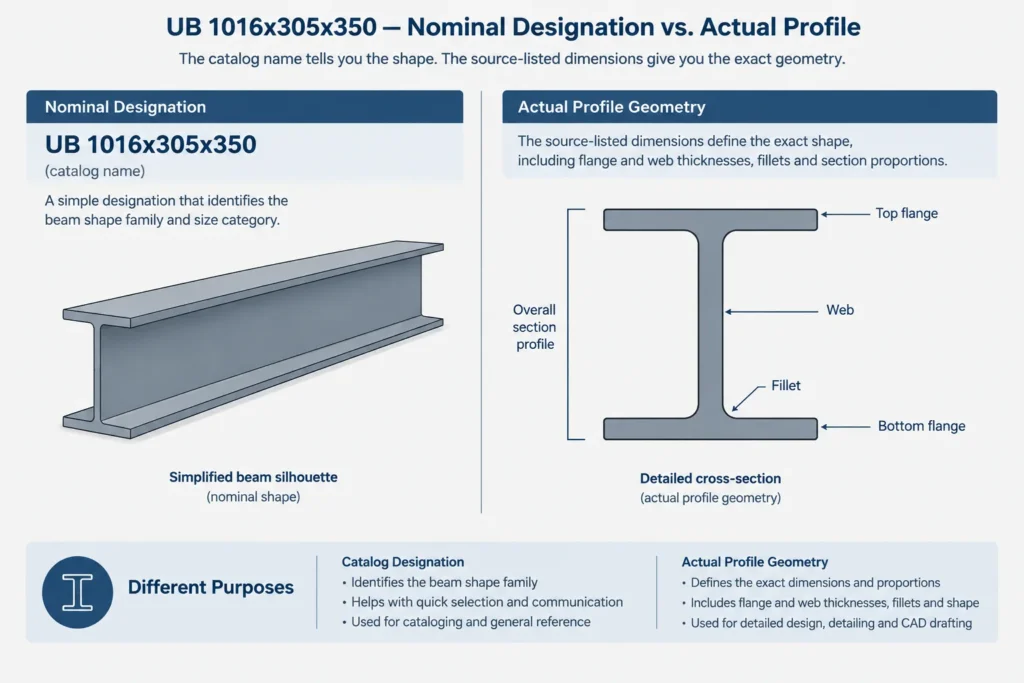
The section designation is a catalog identifier, not a substitute for the detailed geometry. For this profile, the source listing gives an actual depth of 1008 mm and width of 302 mm. Use the complete dimensional data below when checking a section outline, coordinating a model, or preparing a detail.
UB 1016x305x350
Universal Beams
refer to : EN 10365:2017
a European standard that defines the dimensions, tolerances, and sectional properties for hot-rolled steel channels, I-beams, and H-beams used in construction and engineering. It ensures uniformity and compatibility across European structural steel products.
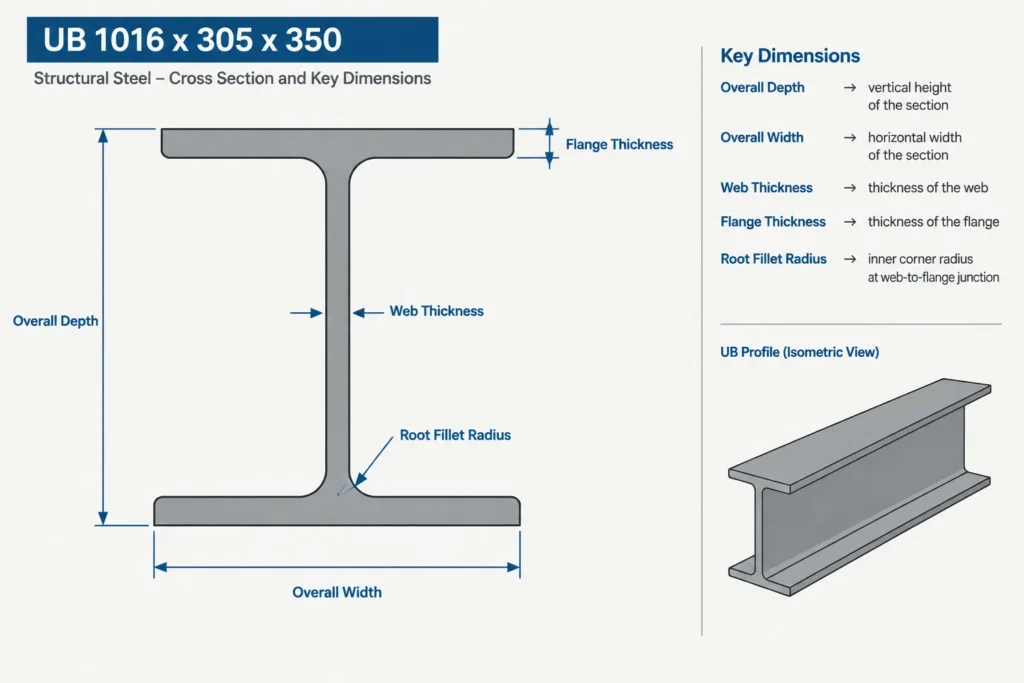
Dimension : 1008x302x21.1×40
Depth : 1008 mm
Width : 302 mm
Web Thickness : 21.1 mm
Flange Thickness : 40 mm
Root Fillet Radius : 30 mm
Sectional Area : 445.1 cm2
Unit Weight : 349.4 kg/m
How to Read the UB Section Data
A universal beam has two flanges connected by a central web. Overall depth and width define the primary envelope, while web thickness, flange thickness, and root fillet radius describe important parts of the cross-sectional geometry.
- Depth and width: Establish the overall section envelope used for layout and clearance checks.
- Web thickness: Describes the thickness of the vertical element between the flanges.
- Flange thickness: Describes the thickness of the horizontal flange elements.
- Root fillet radius: Identifies the curved transition between the web and each flange. This transition matters when checking nearby plates, weld access, and modeled geometry.
- Sectional area: Represents the steel area in the cross-section and is used in section-property and mass relationships.
- Unit weight: The listed 349.4 kg/m expresses mass per unit length, even though steel references commonly label this field as unit weight.
Designation Versus Listed Dimensions
The numbers in a UB designation provide a convenient nominal identity for the section family. They should not be treated as the exact dimensions of every geometric feature. The detailed listing gives the actual overall depth as 1008 mm, overall width as 302 mm, and the separate web, flange, and fillet information needed to describe the profile more completely.
This distinction is especially important in CAD work. Substituting nominal designation numbers for the listed geometry can affect fit-up, clearances, connection layouts, and drawing coordination.
Using the DWG Reference
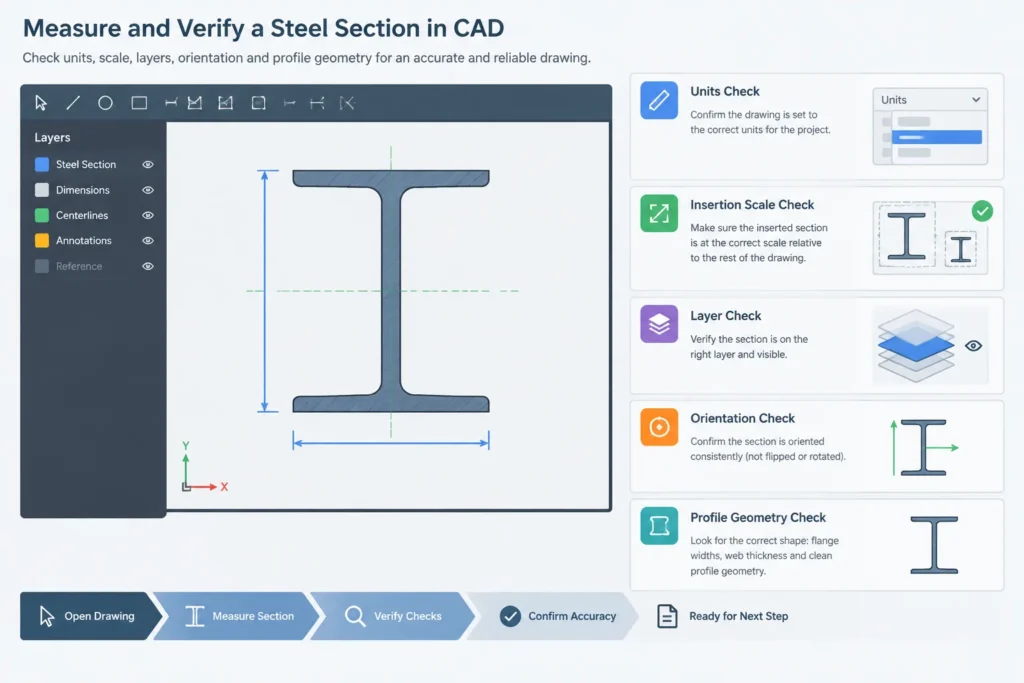
The associated DWG can support section identification, drawing setup, and profile coordination. Before incorporating it into another drawing, confirm the drawing units, insertion scale, layer behavior, orientation, and measured geometry. Compare the CAD profile with the dimensions shown in the preserved source content rather than relying only on the file name.
A section outline does not establish member capacity or connection adequacy. Structural design also depends on material, unbraced length, loading, restraint, stability, connection behavior, and the governing project requirements. Those items require project-specific engineering verification.
Related Reference Topics
Useful companion topics include universal beam dimensions, I-shape terminology, section properties, steel mass-per-length concepts, beam connection detailing, root fillet clearances, and CAD quality-control workflows. Reviewing these subjects together helps connect catalog data with practical drafting and design coordination.
Frequently Asked Questions
What does UB 1016x305x350 mean?
It is the catalog designation for this universal beam profile. The designation provides a nominal identity, while the detailed section listing supplies the actual dimensions and unit weight used for technical reference.
Why is the listed depth 1008 mm instead of the designation value?
Structural-shape designations commonly use nominal identifiers. The listed depth is the actual published geometric value for this profile and should be used when checking the section envelope.
Is 349.4 kg/m a force or a mass per length?
Although the source labels it as unit weight, kg/m expresses mass per unit length. Keep that distinction in mind when using the value in calculations or software workflows.
What is the purpose of the root fillet radius?
The root fillet forms the curved transition between the web and flange. It affects the true profile outline and can influence clearance around plates, welds, fasteners, and modeled connection components.
Can the DWG be used directly in a fabrication or construction drawing?
Use it as a reference and verify its units, scale, layers, geometry, and compatibility with project requirements first. Final fabrication and construction information should be checked by the responsible qualified professional.
Does this page provide the beam capacity?
No. Dimensions, sectional area, and unit weight do not by themselves establish structural capacity. Capacity evaluation requires additional section properties, material information, loading conditions, restraint assumptions, and code-based design checks.