RHS 200x120x6 Section Reference
This page provides a focused dimensional and CAD reference for the RHS 200x120x6 cold-formed welded rectangular steel tube. The designation corresponds to the listed depth, width, and wall thickness, while the source data below also identifies the corner radii, sectional area, and unit weight.
Use the published values when identifying the section in drawings, schedules, material lists, and preliminary models. The accompanying DWG resource can support drafting workflows, but its geometry, units, layers, and suitability should be checked before incorporation into project documents.
RHS 200x120x6
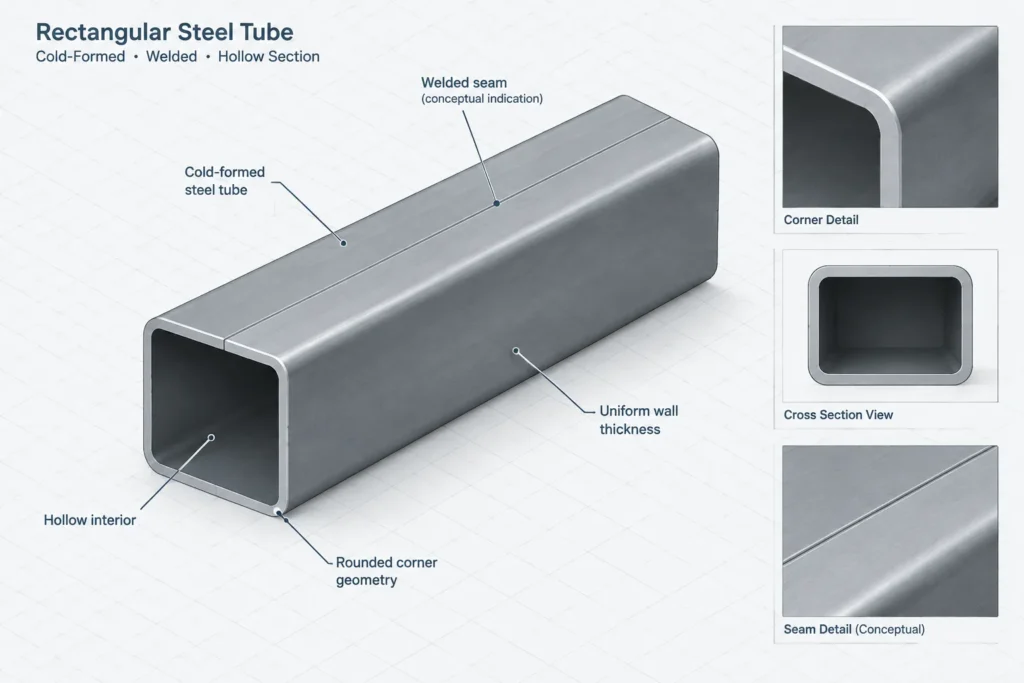
Cold Formed Welded Rectangular Steel Tubes
refer to : EN 10219-2
the European standard that specifies tolerances, dimensions, and sectional properties for cold-formed welded structural hollow sections made of non-alloy and fine grain steels. It complements EN 10219-1, which covers technical delivery conditions.
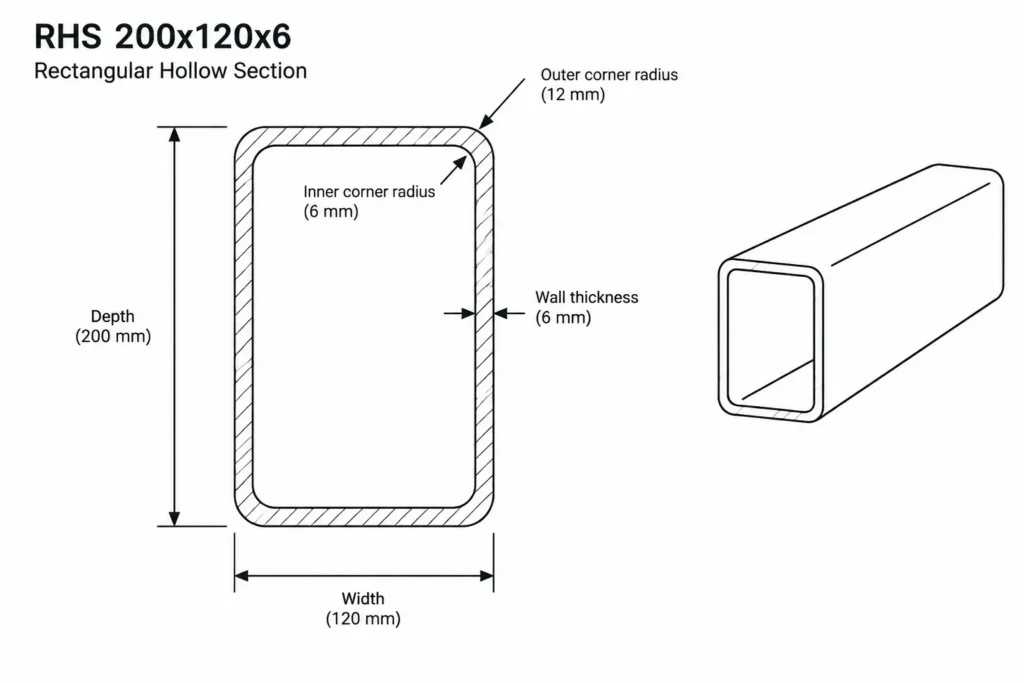
Dimension : 200x120x6
Depth : 200 mm
Width : 120 mm
Thickness : 6 mm
Outer Corner Radius : 12 mm
Inner Corner Radius : 6 mm
Sectional Area : 36.03 cm2
Unit Weight : 28.3 kg/m
How to Read the RHS Designation
For this section, 200x120x6 identifies a depth of 200 mm, a width of 120 mm, and a thickness of 6 mm. Keeping the depth and width in the correct order is important when orienting the section in a model or detail, particularly where bending direction, connection layout, or clearance depends on the rectangular orientation.
Corner Geometry and Drafting
An RHS does not have perfectly square corners. The listed outer corner radius of 12 mm and inner corner radius of 6 mm describe the rounded transitions produced by the section geometry. These radii matter when preparing close-fitting plates, checking local clearances, showing section cuts, or comparing a simplified CAD outline with a more detailed profile.
A schematic rectangle may be adequate for some general arrangement drawings, but connection and fabrication details often require closer attention to the actual corner form. Avoid placing adjoining geometry on the assumption that the inside and outside corners are sharp.
Understanding Area and Unit Weight
The sectional area and unit weight describe different characteristics. Sectional area represents the amount of steel in the cross section, while unit weight states the mass for each meter of member length. Unit weight is useful for material summaries and weight calculations when it is multiplied by the required member length.
Neither value is a load capacity. Structural resistance also depends on material properties, member length, support conditions, loading direction, stability, connection behavior, and the applicable design rules.
EN 10219-2 Context
The source identifies EN 10219-2 as the dimensional reference for this cold-formed welded structural hollow section. In this context, it addresses dimensions, tolerances, and sectional properties, while EN 10219-1 addresses technical delivery conditions. Designers and fabricators should confirm the specified product, material documentation, and applicable project requirements rather than relying on the section designation alone.
Using the CAD Drawing
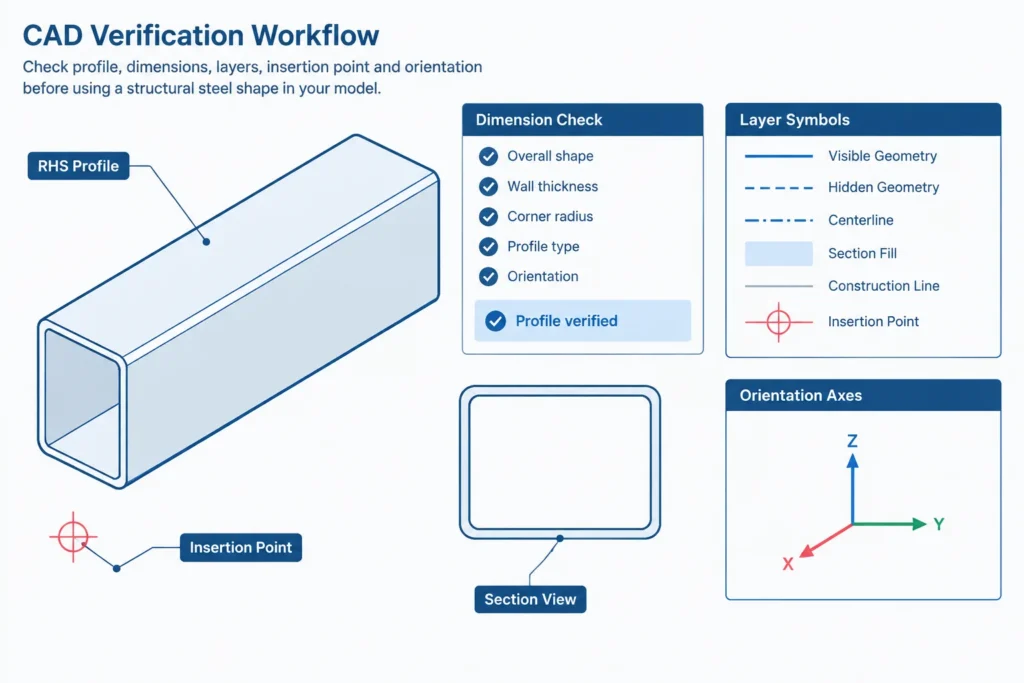
Before using the drawing, verify the file units and compare the CAD geometry with the published depth, width, thickness, and corner radii. Review layer organization, insertion point, orientation, and drawing scale as part of the normal drafting workflow. A downloaded profile should be treated as a reference resource rather than automatic approval for fabrication or structural design.
Related Reference Topics
- Rectangular hollow section dimensions and designation conventions
- HSS and RHS section-property concepts
- Unit weight and material takeoff workflows
- Hollow-section welded and bolted connection detailing
- CAD profile verification and drawing-unit checks
Frequently Asked Questions
What does RHS 200x120x6 mean?
On this page, the designation corresponds to a depth of 200 mm, a width of 120 mm, and a wall thickness of 6 mm.
Why are the inner and outer corner radii different?
The inside and outside faces follow different curved paths through the wall thickness. The listed values are therefore separate dimensions and should not be treated as interchangeable when checking detailed geometry.
Is the sectional area the same as the unit weight?
No. Sectional area describes the steel present in the cross section, while unit weight describes mass per meter of member length. They serve different purposes in section-property review and material takeoffs.
Does the listed unit weight provide the section capacity?
No. Unit weight is a mass-per-length value, not a measure of structural resistance. Capacity requires a design assessment that considers material, loading, member behavior, stability, connections, and applicable requirements.
What should be checked before using the DWG file?
Confirm the CAD units, profile dimensions, wall thickness, corner geometry, orientation, layers, and insertion point. The drawing should also be reviewed against the requirements of the intended project and detailing software.
What is the role of EN 10219-2 here?
The source uses EN 10219-2 as the reference for tolerances, dimensions, and sectional properties of the cold-formed welded structural hollow section. Technical delivery conditions are associated with EN 10219-1.