
This reference page covers the Celsius 355 RHS 80x40x3, a hot-finished rectangular hollow section identified by its depth, width, and wall thickness. The verified source content below provides the principal dimensions, corner radii, sectional area, unit weight, applicable reference standard, and the associated DWG download.
For readers familiar with United States terminology, RHS means rectangular hollow section and is broadly comparable as a shape category to rectangular HSS. That terminology does not make sections from different standards automatically interchangeable. Confirm the governing specification, dimensional tolerances, material requirements, and project criteria before substitution or fabrication.
Celsius 355 RHS 80x40x3
Celsius 355 Rectangular Hollow Sections
refer to : EN 10210-2:2006-04
the European standard that specifies tolerances, dimensions, and sectional properties for hot-finished structural hollow sections of non-alloy and fine grain steels. It supports EN 10210-1, which covers technical delivery conditions.
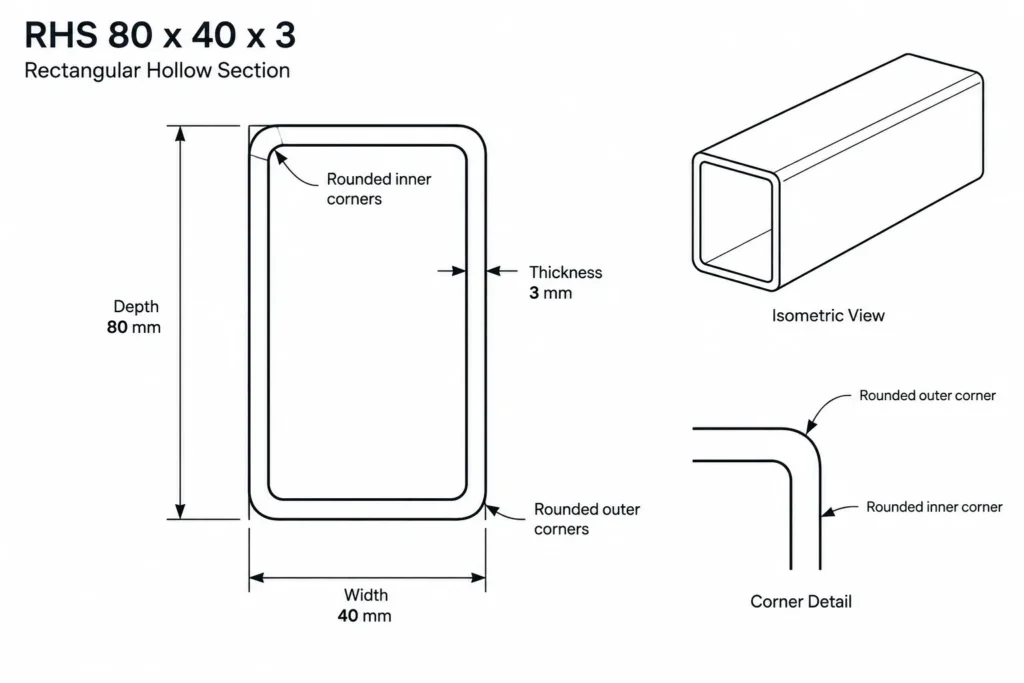
Dimension : 80x40x3
Depth : 80 mm
Width : 40 mm
Thickness : 3 mm
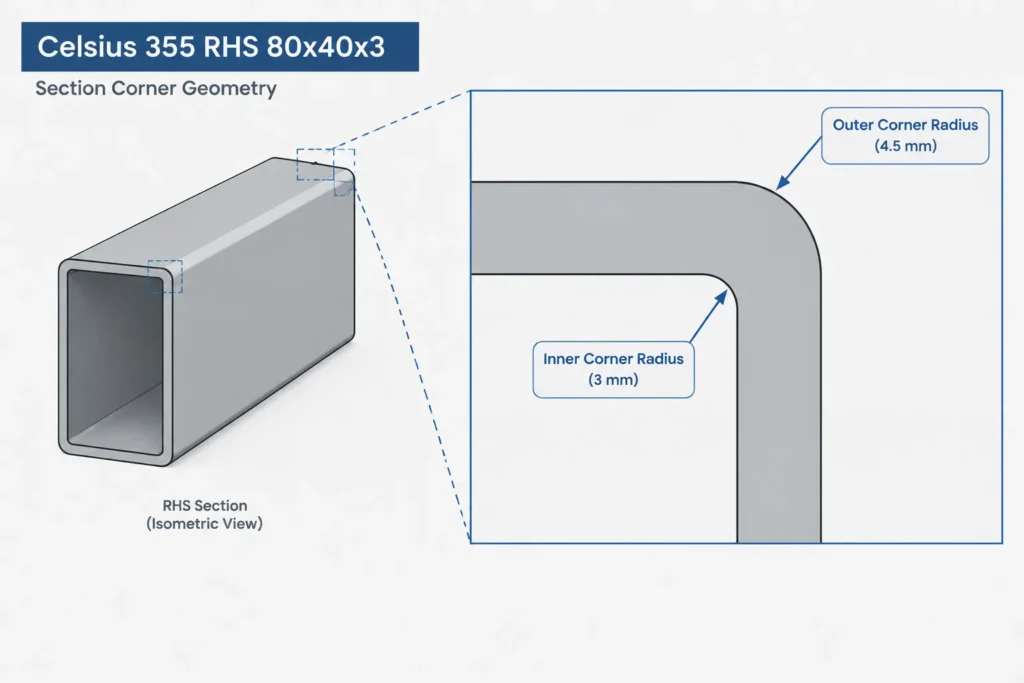
Outer Corner Radius : 4.5 mm
Inner Corner Radius : 3 mm
Sectional Area : 6.74 cm2
Unit Weight : 5.3 kg/m
Understanding the section designation
The designation 80x40x3 identifies the listed overall depth, overall width, and wall thickness. Keeping that order clear is important when creating CAD blocks, assigning local axes, preparing connection details, or comparing the section with other rectangular hollow sections.
How to use the listed properties
The sectional area describes the amount of cross-sectional material represented by the profile. It is commonly used as an input for engineering calculations, but it is not a complete statement of structural capacity. Capacity checks may also depend on material properties, member length, restraint, loading direction, connection behavior, and the applicable design rules.
The unit weight is the mass per unit length. It can support material takeoffs and member-weight estimates when used with the required member length. Allowances for plates, bolts, weld metal, coatings, fittings, and fabrication items should be handled separately where applicable.
Corner radii and CAD geometry
Rectangular hollow sections have rounded corners rather than perfectly square corners. The listed outer and inner corner radii help define a more representative section outline for drafting, interference review, and connection detailing. Simplified sharp-corner geometry may be adequate for some diagrammatic work, but it should not be assumed to represent the actual profile at corner-sensitive details.
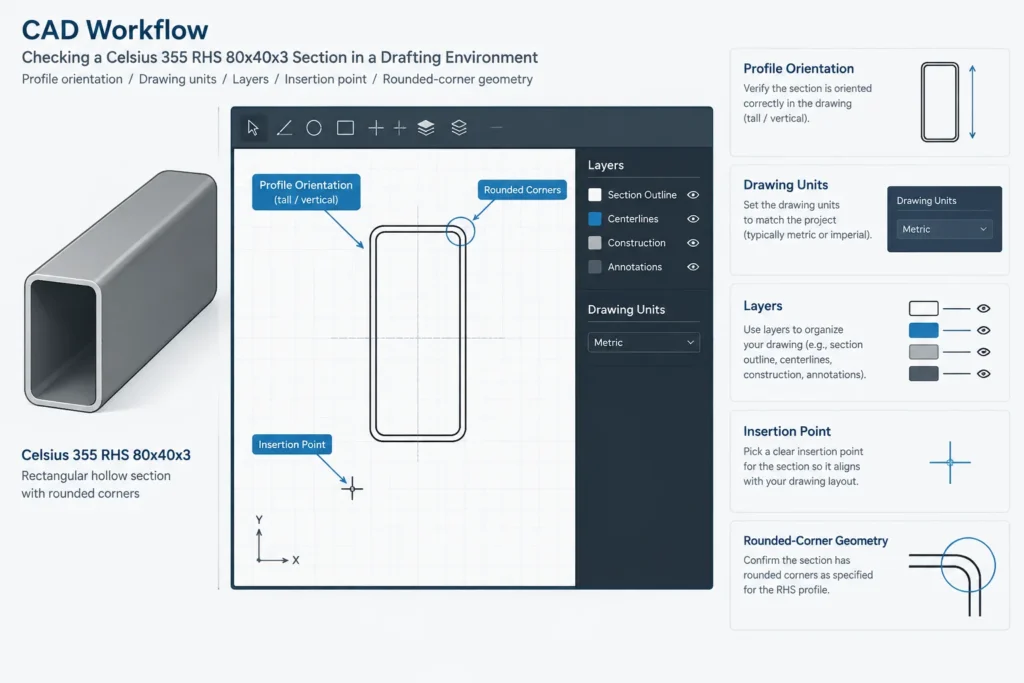
When using the DWG resource, check drawing units, profile orientation, layer organization, and insertion point before incorporating it into another file. The displayed depth, width, thickness, and radii provide practical reference points for reviewing imported or scaled geometry.
Standard and detailing context
The source identifies EN 10210-2:2006-04 as the dimensional and sectional-property reference and notes its relationship to EN 10210-1 for technical delivery conditions. Designers and detailers should use the standard required by the project documents rather than treating a similarly sized section from another product system as an exact replacement.
Related reference topics
- Rectangular hollow section dimensions and designation conventions
- HSS and RHS terminology comparisons
- Sectional area and unit-weight concepts
- Hollow-section corner geometry
- Steel CAD block checking and drawing-unit workflows
- Bolted and welded hollow-section connection concepts
Frequently asked questions
What does Celsius 355 RHS 80x40x3 describe?
It describes a Celsius 355 rectangular hollow section with the dimensions listed in the verified source content: 80 mm depth, 40 mm width, and 3 mm thickness.
Which standard is referenced for this section?
The source references EN 10210-2:2006-04 for tolerances, dimensions, and sectional properties of hot-finished structural hollow sections. It also notes that EN 10210-1 addresses technical delivery conditions.
Why are inner and outer corner radii listed?
The radii describe the curved corner geometry on the outside and inside of the hollow section. They are useful when reviewing section outlines, preparing CAD geometry, or detailing components near the corners.
Is RHS the same as rectangular HSS?
Both terms describe rectangular hollow structural forms, but they are associated with different regional terminology and may be governed by different product standards. A matching nominal size alone does not establish equivalence.
Does the listed unit weight include connections or accessories?
No. Unit weight describes the section per unit length. Connection plates, bolts, welds, fittings, coatings, and other added items require separate consideration.
Can the listed properties be used to determine structural capacity?
They can serve as inputs to engineering calculations, but they do not independently establish capacity. Design must account for the governing code, material requirements, loading, member stability, restraint, connection behavior, and project conditions.
What should be checked after downloading the DWG?
Confirm units, overall dimensions, wall thickness, corner geometry, orientation, layers, and insertion point before using the drawing in a project model or fabrication detail.


