This page provides a focused dimensional and CAD reference for the Celsius 355 RHS 200x150x16 rectangular hollow section. The verified source content below identifies the section size, wall thickness, corner radii, sectional area, unit weight, and the applicable dimensional standard.
Use the listed data when comparing RHS sizes, checking drawing geometry, or preparing a structural-steel model. Section dimensions and mass data are useful for coordination and estimating, but they do not by themselves establish member capacity or suitability for a particular structure.
Celsius 355 RHS 200x150x16
Celsius 355 Rectangular Hollow Sections
refer to : EN 10210-2:2006-04
the European standard that specifies tolerances, dimensions, and sectional properties for hot-finished structural hollow sections of non-alloy and fine grain steels. It supports EN 10210-1, which covers technical delivery conditions.
Dimension : 200x150x16
Depth : 200 mm
Width : 150 mm
Thickness : 16 mm
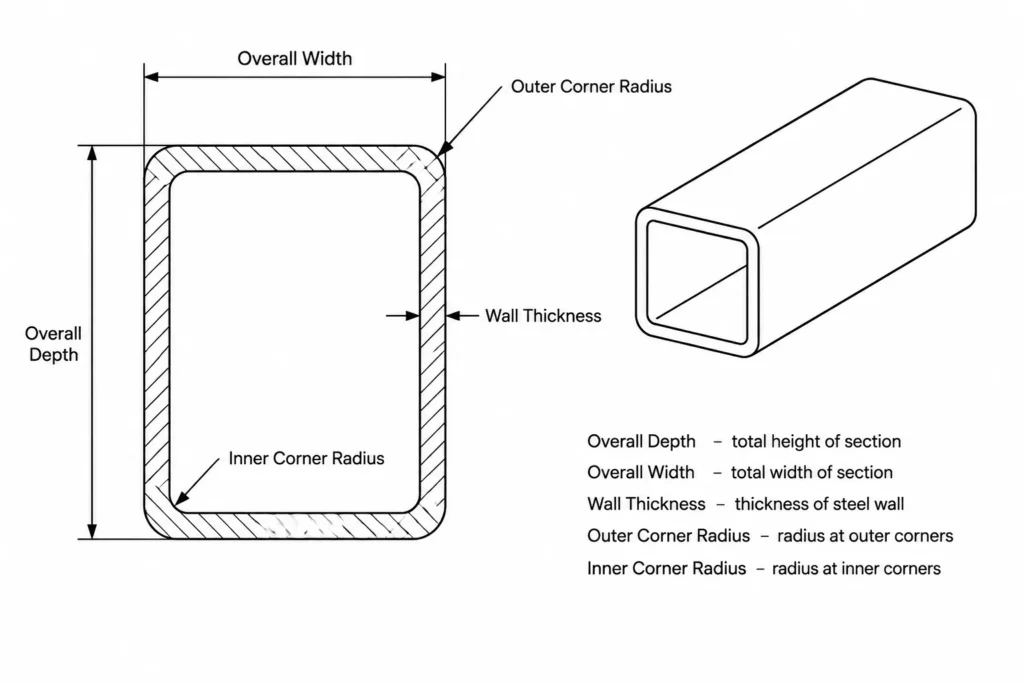
Outer Corner Radius : 24 mm
Inner Corner Radius : 16 mm
Sectional Area : 99 cm2
Unit Weight : 77.7 kg/m
How to Read This RHS Reference
An RHS is a closed structural section with unequal outside depth and width. In the section designation, the dimensions correspond to the overall depth, overall width, and wall thickness shown in the verified data above. Keeping that order consistent is important when identifying the section in schedules, drawings, and CAD libraries.
- Depth and width describe the outside rectangular envelope of the section.
- Thickness identifies the listed wall thickness.
- Outer and inner corner radii describe the curved corner geometry rather than an ideal sharp-cornered rectangle.
- Sectional area represents the steel area in the cross-section and is used in several engineering calculations.
- Unit weight expresses mass per unit length and can support material takeoffs when combined with the required member length.
Orientation and Section Identification
The larger outside dimension is normally treated as the section depth in this listing. A rectangular hollow section may be rotated in a model or assembly, but its orientation affects which geometric axis is being considered. Sectional area and unit weight remain associated with the same profile, while axis-dependent properties and structural behavior must be checked for the actual orientation.
In United States practice, rectangular sections may also be discussed within the broader HSS category. RHS terminology is especially common in European and international product references. Designers and detailers should retain the designation used by the governing project documents rather than treating different naming systems as automatically interchangeable.
Why Corner Radii Matter in Detailing
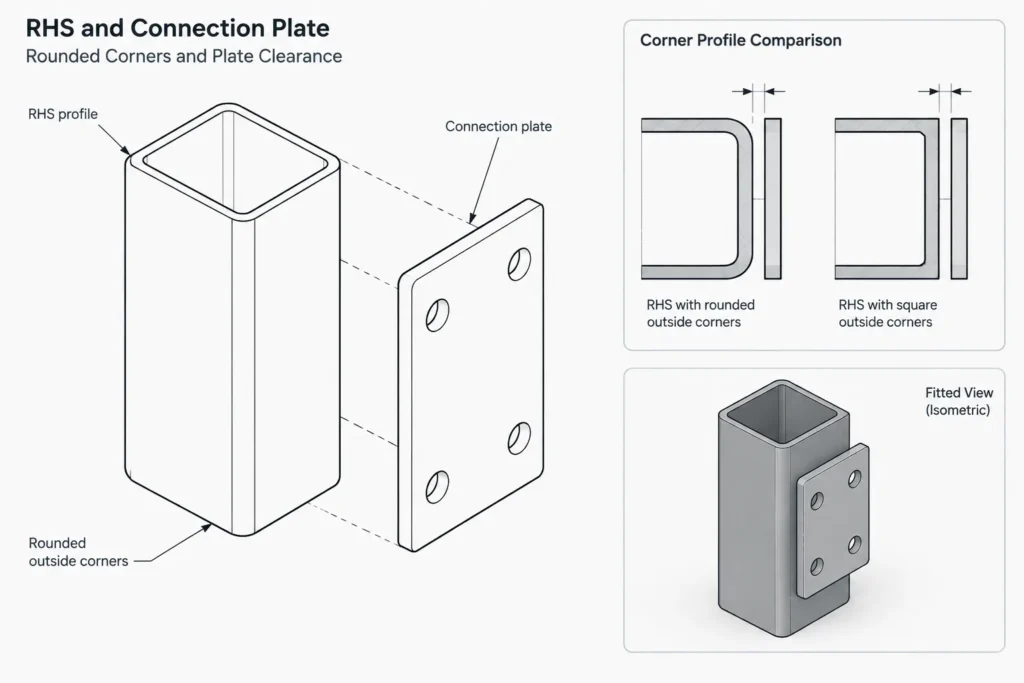
RHS corners are rounded, so the profile should not be modeled as four flat plates meeting at sharp corners. Corner geometry can affect clearances, fitted plates, nearby bolt locations, weld access, and the appearance of section views. For connection detailing, mating components should be coordinated with the actual outside profile rather than only the overall depth and width.
Using the DWG in a CAD Workflow
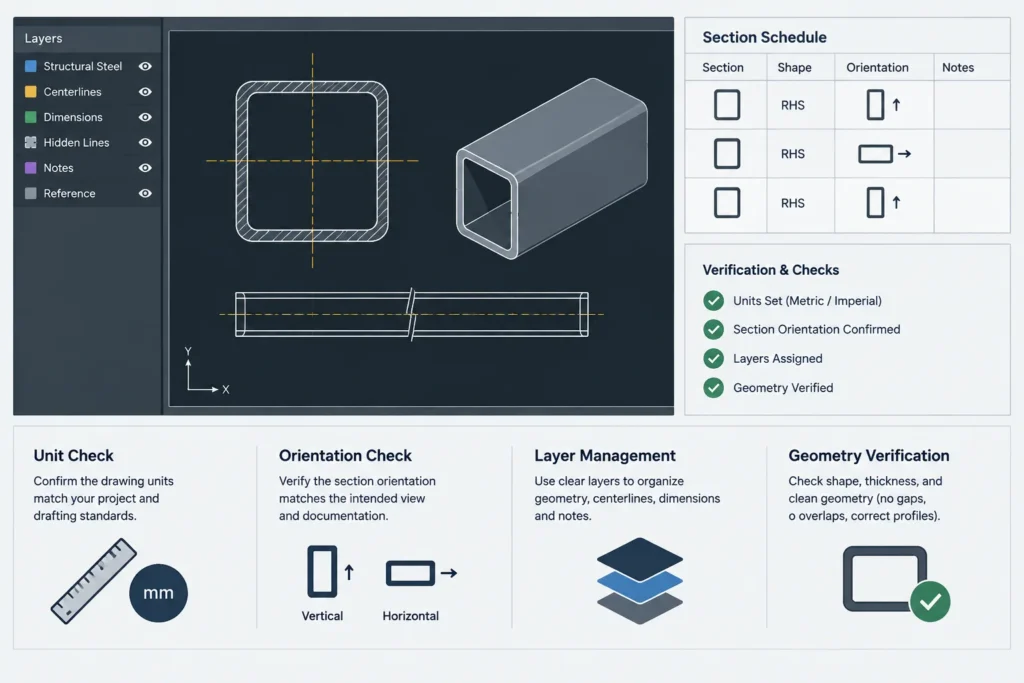
The downloadable drawing can serve as a starting reference for section profiles, details, or steel-shape libraries. After inserting it into a project file, confirm the drawing units, scale, layer organization, profile orientation, and measured geometry. Do not rely on a file name or visual appearance alone when selecting a structural member.
A section-profile drawing does not establish connection design, material certification, fabrication tolerances, or load capacity. Those items require the project specification, applicable design rules, current product information, and professional engineering review. Related references on RHS dimensions, hollow-section properties, steel weight concepts, connection detailing, and CAD blocks can provide useful context for the next stage of the workflow.
Standard Context
The source information associates this section with the stated European hollow-section dimensional standard. That reference provides the context for dimensions, tolerances, and sectional-property conventions, while technical delivery requirements are addressed separately as noted in the original content. Always confirm that the cited standard and product designation match the requirements of the current project.
Frequently Asked Questions
What does the RHS size designation represent?
It identifies the listed overall depth, overall width, and wall thickness in that order. The verified values are provided in the original reference block above.
Is an RHS the same as an HSS?
RHS identifies a rectangular hollow section. HSS is a broader term commonly used in United States practice for structural hollow sections, including rectangular forms. Naming, manufacturing requirements, and dimensional conventions should be checked against the applicable product standard rather than assumed to be identical.
Can unit weight be used for a material takeoff?
Yes. Unit weight can be combined with the required member length to estimate member mass. Takeoffs should also account for the actual cut list, quantities, connections, plates, and other project-specific items.
Does sectional area indicate load capacity?
No. Sectional area is one geometric property, not a complete capacity rating. Structural performance also depends on material properties, member length, support conditions, loading, orientation, connection behavior, and other section properties.
Can the DWG be issued directly for fabrication?
It should be treated as a reference resource and verified within the project workflow. Fabrication documents require checked dimensions, correct units, connection information, tolerances, material requirements, and approval appropriate to the project.