UPE 400 is a hot-rolled European parallel flange channel. Its open cross-section consists of a web connecting two flanges, while the parallel flange faces can simplify positioning, connection layout, and CAD representation.
The verified reference below provides the section designation, principal dimensions, sectional area, unit weight, root fillet radius, and applicable standard reference. These values are useful for section identification and preliminary drafting, but they do not replace project-specific structural calculations or material specifications.
UPE 400
Parallel Flange Channels
refer to : EN 10365:2017
a European standard that defines the dimensions, tolerances, and sectional properties for hot-rolled steel channels, I-beams, and H-beams used in construction and engineering. It ensures uniformity and compatibility across European structural steel products.
Dimension : 400x115x13.5×18
Depth : 400 mm
Width : 115 mm
Web Thickness : 13.5 mm
Flange Thickness : 18 mm
Root Fillet Radius : 18 mm
Sectional Area : 91.9 cm2
Unit Weight : 72.1 kg/m
How to Read the UPE 400 Reference
The dimension listing describes the overall depth and width together with the web and flange thicknesses. The root fillet radius identifies the curved transition between the web and each flange. That curved region is important when checking clearances for plates, bolts, weld access, and adjacent components.
Sectional area represents the area of steel in the cross-section. Unit weight, commonly expressed as mass per unit length in metric section references, supports quantity takeoffs and member mass estimates. It should not be treated as a load capacity or as the total installed weight of an assembly.
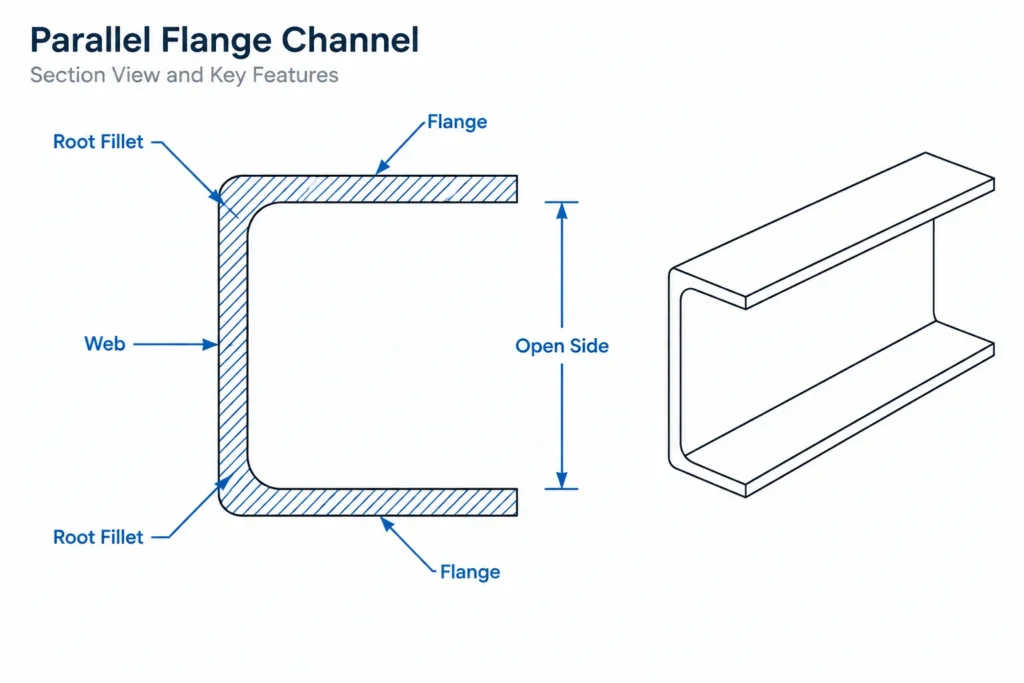
Parallel Flange Channel Geometry
A UPE section has parallel flange faces rather than tapered flange faces. This distinction matters when selecting a channel family, developing connection details, or comparing the section with other European channels. Similar-looking channel designations are not automatically interchangeable because their geometry, sectional properties, and detailing clearances can differ.
The channel is an open section, so its behavior depends on member orientation, restraint, connection eccentricity, and the axis about which bending occurs. Designers should use the complete verified section-property data required by the applicable calculation method rather than inferring capacity from depth or unit weight alone.
Using the UPE 400 DWG
The supplied DWG can support section identification, layout work, and detail development. Before incorporating it into a drawing set, confirm the drawing units, insertion scale, layer organization, linework, and orientation. The CAD geometry should also be checked against the listed source dimensions and the requirements of the project.
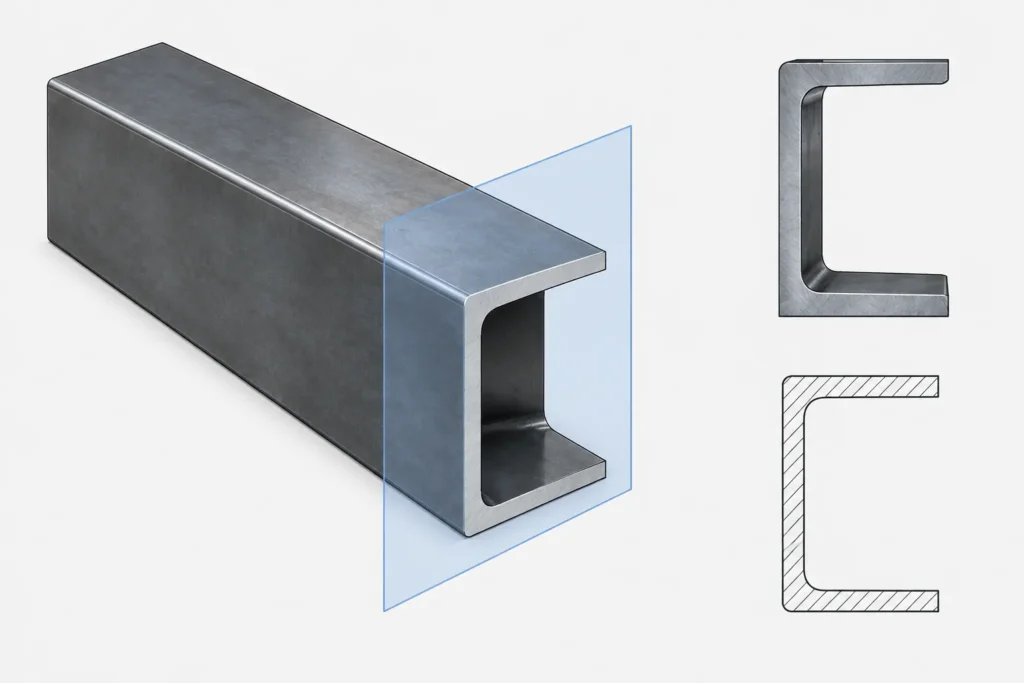
For connection detailing, allow for the root fillets and actual flange and web faces. Simplified sharp-corner channel outlines may be adequate for diagrams, but they can conceal interference near the web-to-flange transition. Fabrication details should show the intended member orientation and provide enough information to avoid confusion between the web, flange tips, and channel opening.
Related Reference Topics
- European steel channels: Compare UPE geometry with other channel series before selecting or substituting a section.
- Section properties: Review area, centroid, moments of inertia, section moduli, and radii of gyration when those properties are required for analysis.
- Steel weight calculations: Use unit weight with the required member length, then account separately for plates, fasteners, weld metal, and other attached items.
- Channel connections: Consider eccentric load paths, local clearances, bolt access, weld access, and member restraint.
- CAD drafting: Verify units and geometry before reusing a downloaded steel-section block in production drawings.
UPE 400 Frequently Asked Questions
What type of section is UPE 400?
It is a European hot-rolled parallel flange channel. The section has one web and two flanges forming an open channel profile.
Which standard is referenced for this section?
The source identifies EN 10365:2017 as the dimensional and sectional-property reference.
What does the UPE 400 dimension notation describe?
The listed notation summarizes the section depth, flange width, web thickness, and flange thickness. The individual labeled values in the preserved reference should be used to avoid misreading their order.
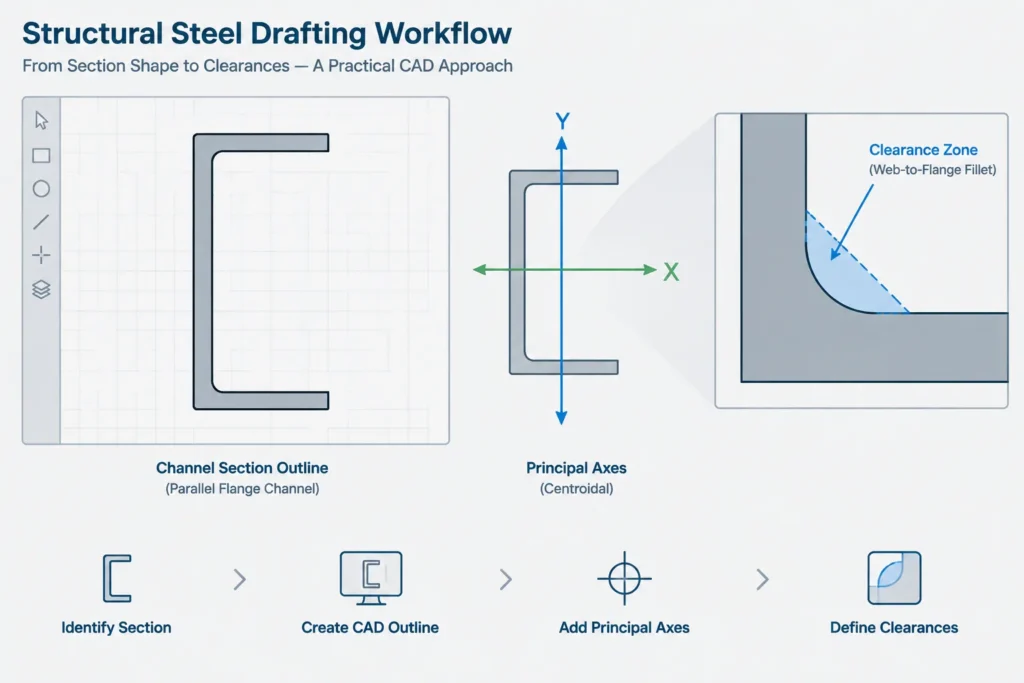
Why does the root fillet radius matter in drafting?
The root fillet occupies space where the web and flange meet. Plates, bolt heads, welds, and fitted components should not be detailed as though that transition were a sharp internal corner.
Is unit weight the same as structural capacity?
No. Unit weight describes member mass per unit length. Capacity depends on additional factors, including material specification, member length, restraint, loading, orientation, connection behavior, and the applicable design rules.
Can the DWG be issued directly for fabrication?
The file should first be checked for units, scale, geometry, layers, and compatibility with the project requirements. A CAD reference does not replace engineering review or fabrication-specific detailing.