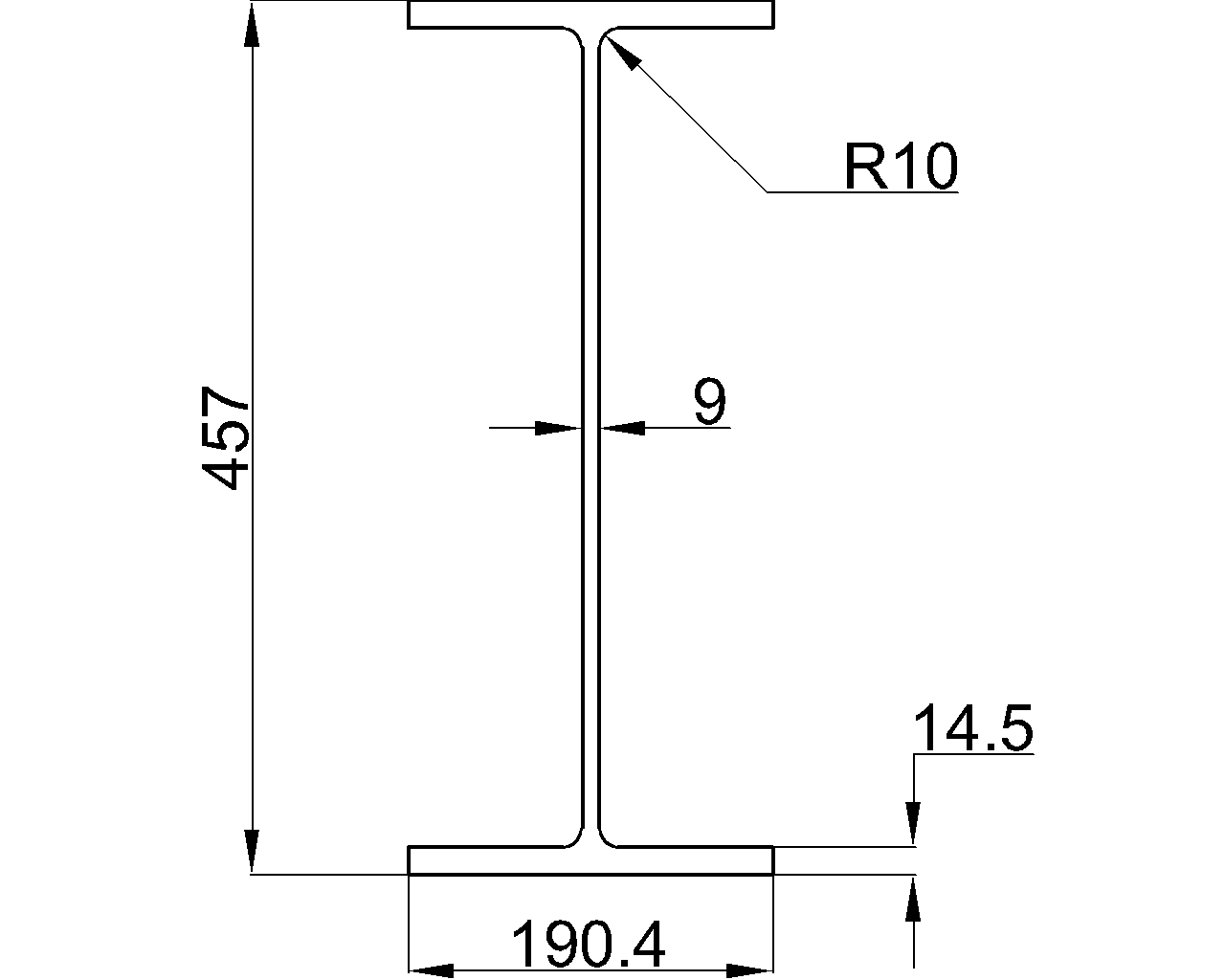
The UB 457x191x74 is a Universal Beam reference entry for engineers, detailers, fabricators, and CAD users working with European structural steel profiles. Use the source data below to confirm the listed dimensions, sectional area, and unit weight before preparing drawings, schedules, or material takeoffs.
The designation identifies the beam series and its nominal size and mass class, while the detailed dimensions provide the values needed for clearer communication between design, detailing, procurement, and fabrication teams.
UB 457x191x74
Universal Beams
refer to : EN 10365:2017
a European standard that defines the dimensions, tolerances, and sectional properties for hot-rolled steel channels, I-beams, and H-beams used in construction and engineering. It ensures uniformity and compatibility across European structural steel products.
Dimension : 457×190.4x9x14.5
Depth : 457 mm
Width : 190.4 mm
Web Thickness : 9 mm
Flange Thickness : 14.5 mm
Root Fillet Radius : 10 mm
Sectional Area : 94.6 cm2
Unit Weight : 74.3 kg/m
Understanding the UB 457x191x74 designation
Universal Beams are hot-rolled structural steel sections with a web and flanges arranged to provide an efficient beam profile. The designation is commonly used as a concise way to identify a section in structural drawings, steel schedules, design calculations, and CAD libraries.
For this entry, the listed depth, width, web thickness, flange thickness, root fillet radius, sectional area, and unit weight should be read together. The nominal designation and the detailed dimension line are not substitutes for one another: the detailed values are the appropriate reference when checking clearances, connection details, end conditions, or fabrication information.
How to use the dimensional data
The depth and width help establish the envelope of the section for layout and coordination. Web and flange thicknesses are important when developing connection details, checking interfaces, and coordinating plates, stiffeners, bolts, or welds. The root fillet region also matters where an attached component must fit closely against the rolled profile.
Sectional area and unit weight support material estimates and steelwork documentation. They should not be treated as a substitute for the complete section-property set or for engineering verification of resistance, stability, deflection, fire performance, or connection behavior.
Reference and drafting workflow
The source identifies EN 10365:2017 as the dimensional reference. When using this profile in a project, compare the section designation with the project specification, material grade requirements, connection design, and the approved fabrication information. A CAD or DWG file can assist with drafting, but the drawing should still be checked against the authoritative project and manufacturer documentation.
For related research, connect this page with internal references covering Universal Beam terminology, steel connection detailing, section properties, and structural steel CAD and DWG resources.
Frequently asked questions
What is a UB 457x191x74?
It is a Universal Beam designation used to identify a hot-rolled structural steel section. The page provides its corresponding detailed dimensions, sectional area, and unit weight.
What standard is referenced for this section?
The source references EN 10365:2017, which covers dimensional and related section information for European hot-rolled steel profiles.
Why are both a section designation and detailed dimensions shown?
The designation provides a concise identification for schedules and drawings, while the detailed dimensions support coordination, detailing, and checking of the actual profile geometry listed in the reference.
Can the listed unit weight be used to design the beam?
Unit weight is useful for material estimates and documenting self-weight assumptions. It does not by itself establish structural capacity or serviceability. Those checks require the applicable design standard, material information, loading, restraint conditions, and engineering review.
Is the DWG file sufficient for fabrication?
No. A DWG reference can support drafting and coordination, but fabrication should follow approved project drawings, specifications, tolerances, and verified procurement information.


