This reference page covers the Celsius 355 RHS 450x150x8.8, a hot-finished rectangular hollow section identified by its depth, width, and wall thickness. The verified section data and DWG resource below support profile identification, preliminary coordination, and CAD-based detailing.
Because this is a metric RHS associated with a European hollow-section standard, users working in a United States drafting environment should confirm drawing units, specification requirements, and section availability before incorporating it into project documents.
Celsius 355 RHS 450x150x8.8
Celsius 355 Rectangular Hollow Sections
refer to : EN 10210-2:2006-04
the European standard that specifies tolerances, dimensions, and sectional properties for hot-finished structural hollow sections of non-alloy and fine grain steels. It supports EN 10210-1, which covers technical delivery conditions.
Dimension : 450x150x8.8
Depth : 450 mm
Width : 150 mm
Thickness : 8.8 mm
Outer Corner Radius : 13.2 mm
Inner Corner Radius : 8.8 mm
Sectional Area : 102 cm2
Unit Weight : 80.1 kg/m
How to read the RHS designation
RHS means rectangular hollow section. In the 450x150x8.8 designation, the values identify the overall depth, overall width, and wall thickness shown in the source data. The unequal outside dimensions distinguish this profile from a square hollow section and create strong and weak section orientations that must be recognized in modeling and detailing.
Quick section reference
- Section: Celsius 355 RHS 450x150x8.8
- Overall depth: 450 mm
- Overall width: 150 mm
- Wall thickness: 8.8 mm
- Outer corner radius: 13.2 mm
- Inner corner radius: 8.8 mm
- Sectional area: 102 cm²
- Unit weight: 80.1 kg/m
- Referenced dimensional standard: EN 10210-2:2006-04
Why the corner radii matter
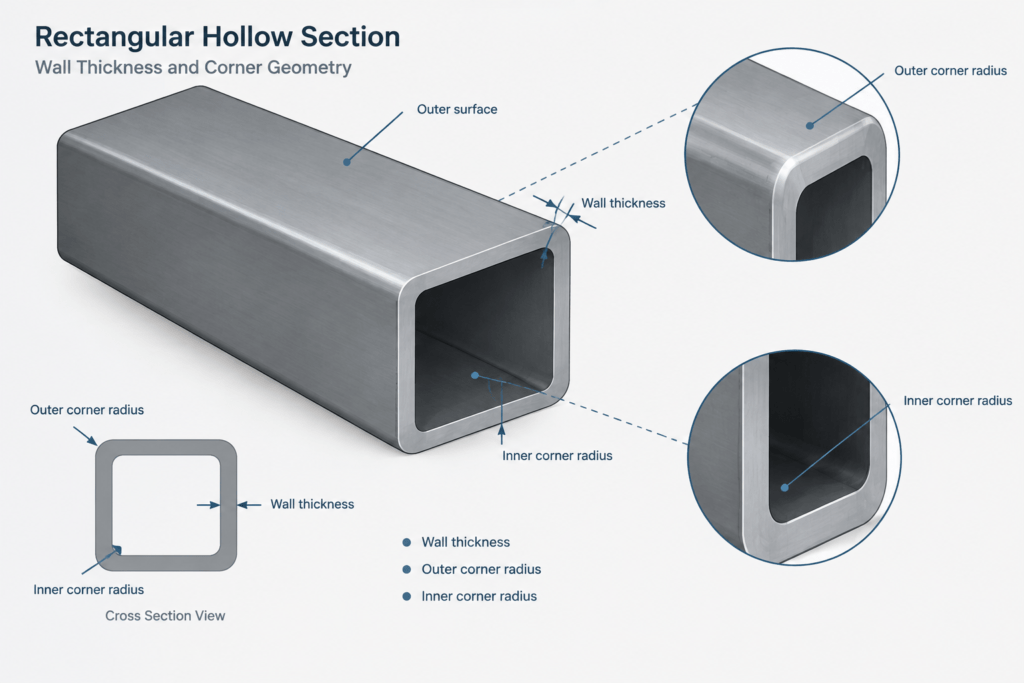
An RHS is not modeled accurately as four flat plates meeting at sharp corners. The inside and outside radii affect the profile outline, connection clearances, local fit-up, and the appearance of section views. They are particularly relevant when positioning plates, weld preparations, bolts, or adjacent members near a rounded corner.
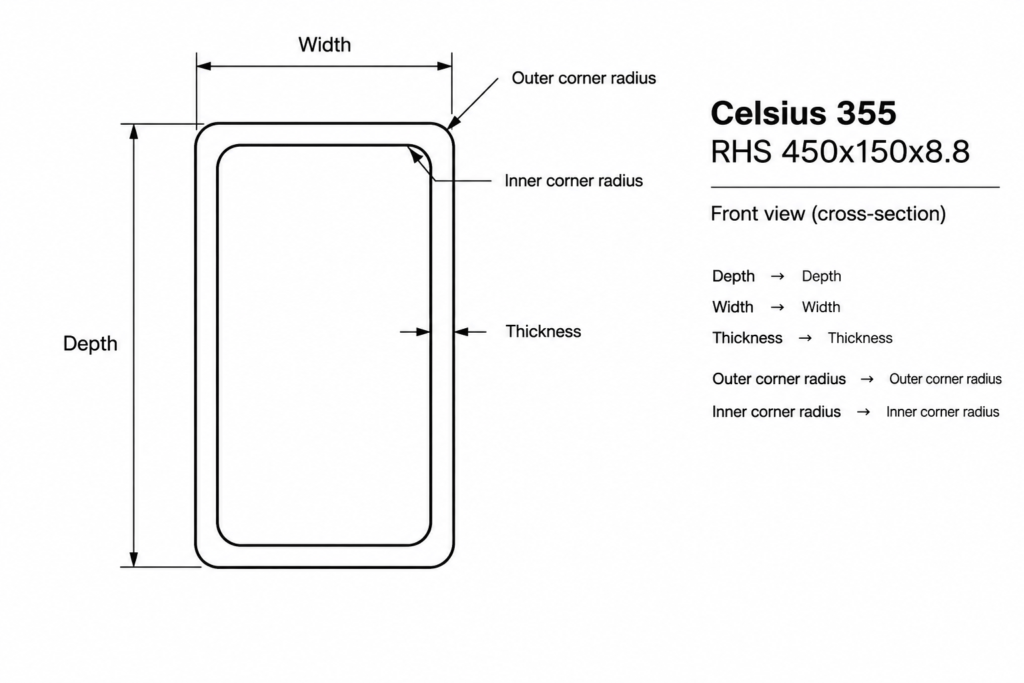
For general arrangement drawings, a simplified outline may sometimes be adequate. Fabrication-oriented models and connection details should retain or verify the specified corner geometry rather than assuming square corners.
Using the sectional area and unit weight
Sectional area describes the amount of steel in the cross-section and is a starting point for several engineering and quantity-related calculations. Unit weight expresses the mass per length of the member. Multiplying the listed unit weight by the required member length provides a theoretical member mass before accounting for attached plates, connection material, coatings, or other project-specific items.
The values on this page should not be treated as a complete structural design dataset. Properties such as moments of inertia, radii of gyration, section moduli, torsional properties, and design resistances require verified reference data and the applicable design method.
Standard and specification context
The source identifies EN 10210-2:2006-04 for tolerances, dimensions, and sectional properties of hot-finished structural hollow sections, with EN 10210-1 addressing technical delivery conditions. A section designation alone does not establish every procurement or design requirement. Material documentation, product availability, tolerances, and the governing project specification should also be checked.
Users familiar with United States HSS terminology should not assume that a European RHS designation is automatically interchangeable with a similarly sized domestic HSS. Confirm the governing standard, manufacturing route, dimensions, corner geometry, material requirements, and engineering properties.
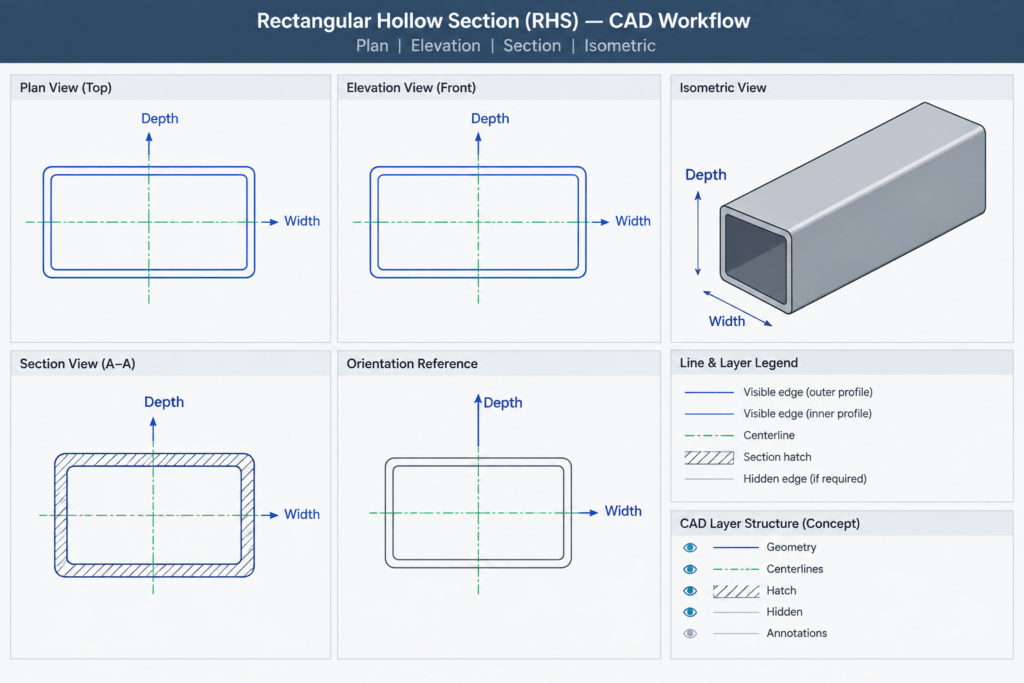
CAD and detailing workflow
- Confirm units: Check that the imported DWG geometry is interpreted in millimeters and has not been rescaled by the receiving software.
- Inspect the profile: Verify the overall dimensions, wall thickness, and rounded corners against the listed reference data.
- Check orientation: Ensure the depth and width are aligned correctly in plans, elevations, sections, and analytical models.
- Review connection clearance: Account for corner curvature when placing plates, welds, bolts, stiffeners, or intersecting members.
- Validate before issue: Confirm the CAD geometry and section properties against the project specification and current approved product information.
Related reference topics
Useful supporting topics include rectangular hollow-section dimensions, HSS and RHS terminology, strong-axis and weak-axis orientation, section-property definitions, metric drawing units, hollow-section corner geometry, welded connections, bolted connections, and DWG import verification.
Frequently asked questions
What does 450x150x8.8 mean?
It identifies the listed overall depth, overall width, and wall thickness of the rectangular hollow section, in that order.
Is this section square or rectangular?
It is rectangular because its overall depth and width are different. The orientation of those dimensions should be checked when the profile is placed in a model or drawing.
Which standard is referenced for this section?
The supplied source references EN 10210-2:2006-04 for dimensional tolerances and sectional information for hot-finished structural hollow sections. It also notes that EN 10210-1 addresses technical delivery conditions.
Can the DWG be used directly for fabrication?
The DWG can support drafting and coordination, but it should be checked for units, scale, profile geometry, corner radii, and compatibility with the project specification before fabrication information is issued.
Why are both inner and outer corner radii listed?
The two radii define the curved wall geometry at each corner. They influence the profile outline and available clearance for connection components near the corners.
Does this page provide structural capacity?
No. The listed dimensions, area, and unit weight do not by themselves establish member or connection capacity. Structural verification requires additional section properties, material information, loading, boundary conditions, and the applicable design rules.
Is a European RHS the same as a United States HSS?
The terms describe closely related closed structural shapes, but designations from different standards should not be assumed to be interchangeable. Verify dimensions, tolerances, corner geometry, material requirements, and section properties.