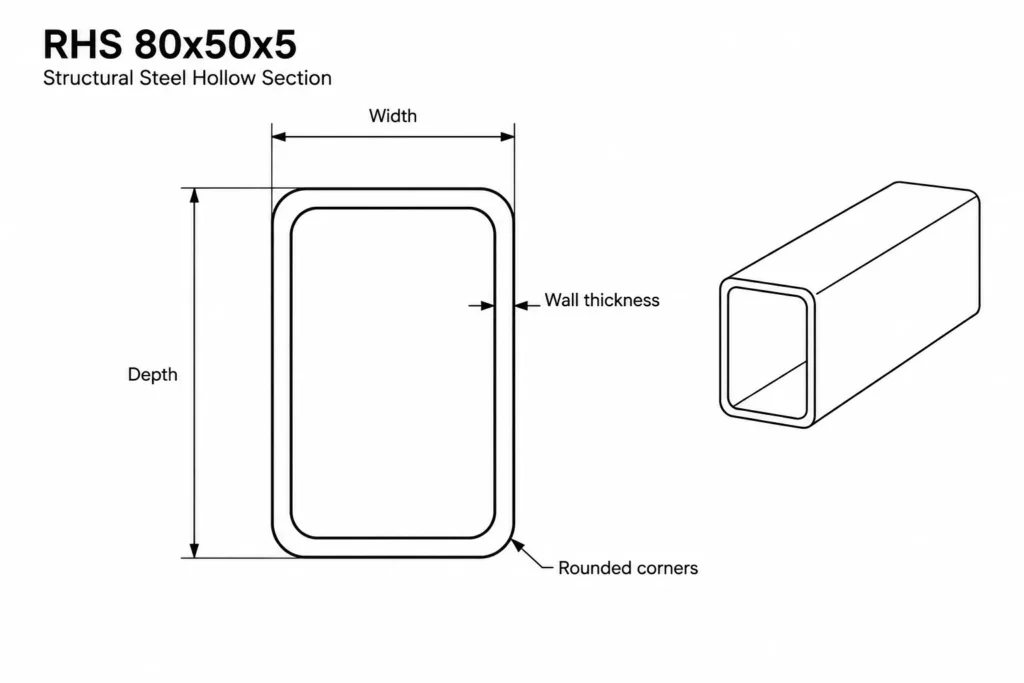
RHS 80x50x5 is a cold-formed welded rectangular steel hollow section identified by its overall depth, width, and wall thickness. The reference information below provides the principal dimensions, corner radii, sectional area, and unit weight associated with this section.
This page is intended as a practical reference for section identification, drawing coordination, preliminary layout, and CAD workflows. The listed data should be read together because the outside dimensions, wall thickness, and rounded corners collectively define the section geometry.
RHS 80x50x5
Cold Formed Welded Rectangular Steel Tubes
refer to : EN 10219-2
the European standard that specifies tolerances, dimensions, and sectional properties for cold-formed welded structural hollow sections made of non-alloy and fine grain steels. It complements EN 10219-1, which covers technical delivery conditions.
Dimension : 80x50x5
Depth : 80 mm
Width : 50 mm
Thickness : 5 mm
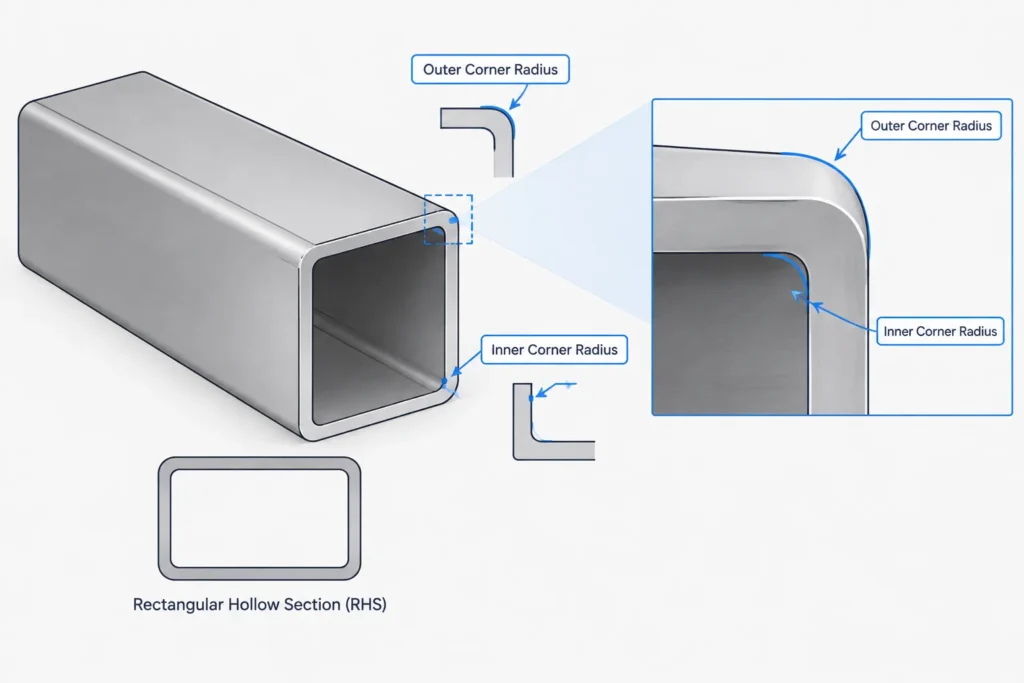
Outer Corner Radius : 10 mm
Inner Corner Radius : 5 mm
Sectional Area : 11.36 cm2
Unit Weight : 8.9 kg/m
Understanding the RHS 80x50x5 designation
RHS means rectangular hollow section. In the designation RHS 80x50x5, the first two values identify the outside depth and width, while the final value identifies the wall thickness. Keeping this order consistent is important when labeling members, preparing schedules, or rotating the section in a drawing.
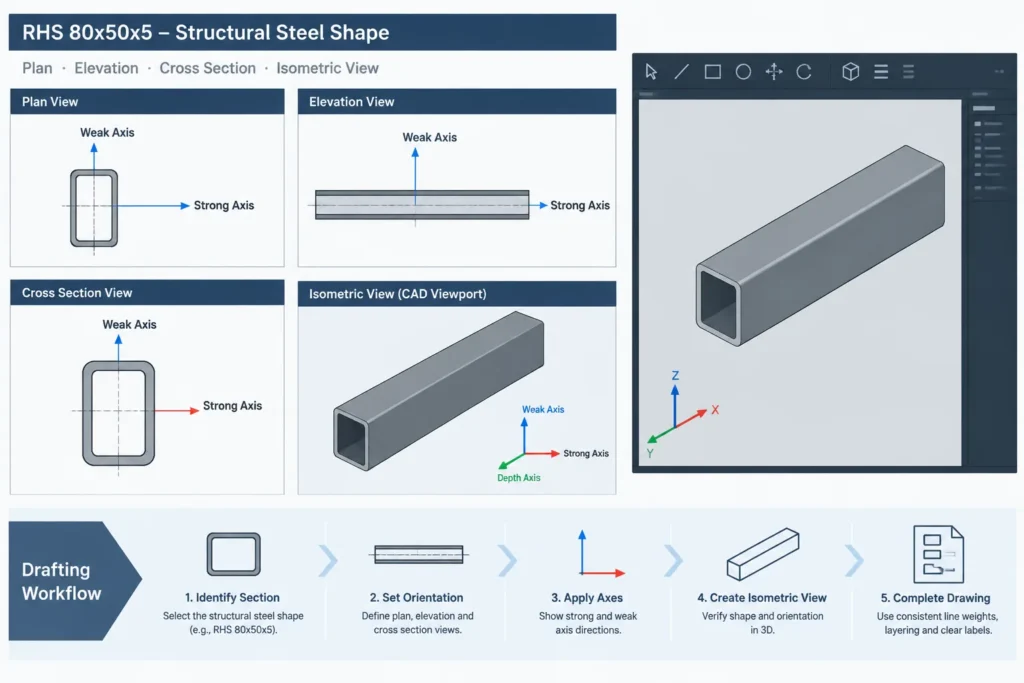
Although the section can be turned to suit a drawing or framing arrangement, its strong-axis and weak-axis orientation changes when the depth and width are interchanged on the page. Drafters should therefore show the intended orientation clearly rather than relying only on the section name.
Corner radii and section geometry
A rectangular hollow section does not have perfectly square corners. The outer and inner corner radii listed in the source data describe the curved transitions between adjacent walls. These curves affect the exact cross-sectional outline, the lengths of the flat wall portions, and the sectional area.
For general arrangement drawings, a simplified rectangular outline may sometimes be visually sufficient. For fabrication details, close-clearance components, connection plates, or section-property work, the rounded corners should be represented or otherwise accounted for.
How to use the listed section data
- Depth and width: Use these values to establish the overall section envelope and orientation.
- Wall thickness: Use the listed thickness when interpreting the hollow profile and coordinating attached components.
- Corner radii: Check these values where plates, weld access, bolts, or other parts approach a corner.
- Sectional area: This describes the amount of steel in the cross section and supports section-property and weight-related calculations.
- Unit weight: This gives the mass per unit length. Total member mass depends on the actual member length and any added plates, fittings, or connection components.
EN 10219-2 reference context
The source identifies EN 10219-2 as the dimensional and sectional-property reference for this cold-formed welded rectangular hollow section. That context helps distinguish the section from similarly named products referenced under other standards or manufacturing routes.
A designation alone should not be treated as a complete procurement or fabrication specification. Project documents may also need to address material grade, technical delivery requirements, tolerances, finish, inspection, and connection requirements. These items should be confirmed against the governing project specification and applicable standard documents.
Using the DWG in a drafting workflow
The DWG resource can support section-detail development, profile reference, and drawing coordination. After inserting or opening the file, verify the drawing units, scale, layer organization, and profile dimensions before incorporating it into a project drawing.
CAD geometry is a drafting aid rather than a substitute for design review. Connection fit, local clearances, weld details, bolt placement, member capacity, and fabrication requirements must be checked for the actual application by the responsible technical professional.
Related reference topics
Useful companion topics include rectangular hollow section dimensions, HSS and RHS terminology, section-property concepts, steel unit weight, hollow-section connections, welded connection detailing, and CAD block verification. Reviewing these subjects together helps connect the section profile with its use in schedules, calculations, and fabrication drawings.
Frequently asked questions
What does RHS 80x50x5 mean?
It identifies a rectangular hollow section with an outside depth of 80 mm, an outside width of 50 mm, and a wall thickness of 5 mm.
What are the listed corner radii?
The source data gives an outer corner radius of 10 mm and an inner corner radius of 5 mm. These radii describe the curved corners rather than sharp right-angle transitions.
What sectional area and unit weight are listed?
The listed sectional area is 11.36 cm², and the listed unit weight is 8.9 kg/m.
Why does section orientation matter?
The section has different overall depth and width dimensions. Rotating it changes which dimension is vertical or horizontal in the drawing and changes the orientation of its section-property axes.
Can the DWG be used directly for fabrication?
It should first be checked for units, scale, dimensions, corner geometry, and compatibility with the project requirements. Fabrication and connection details require project-specific verification.
Which standard is referenced for this section?
The source content refers to EN 10219-2 for tolerances, dimensions, and sectional properties of cold-formed welded structural hollow sections.